Casino Management System for Online Casinos: The Operator's Complete Guide for 2026
What is a casino management system and what does it actually control?
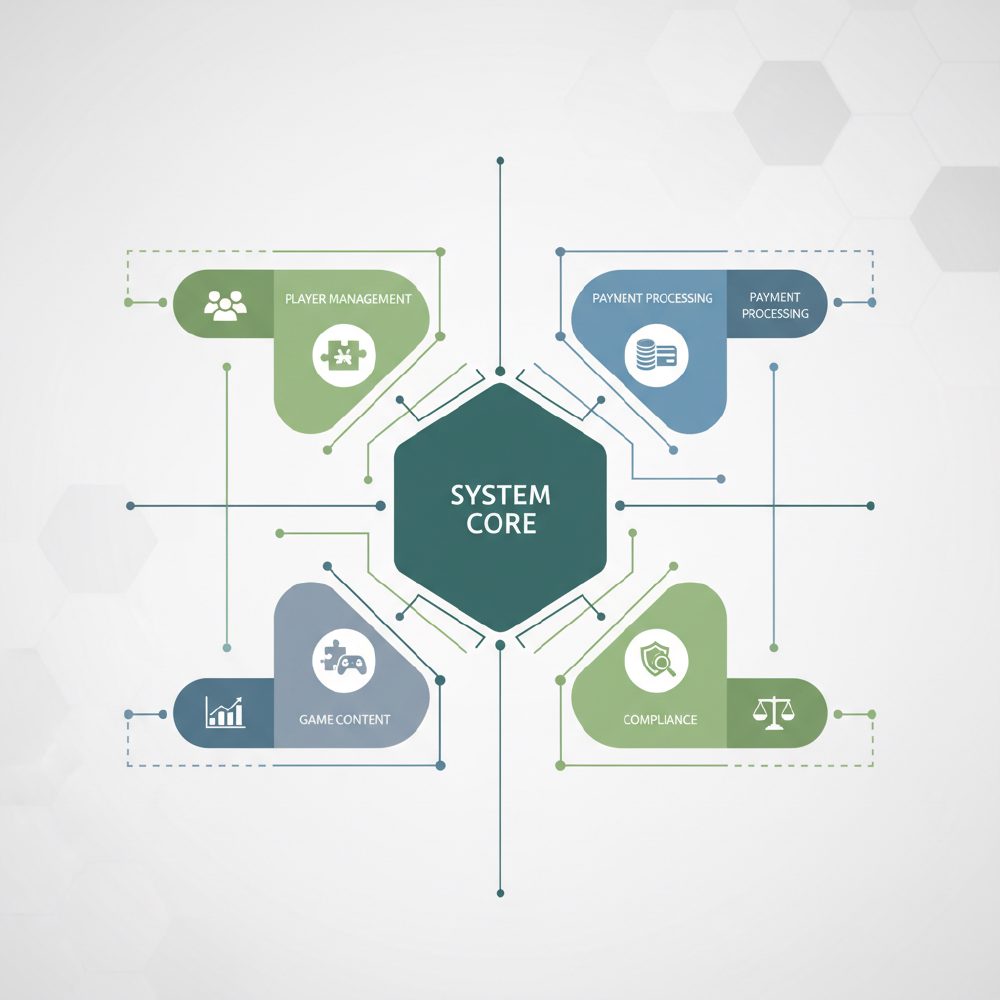
A casino management system is the administrative software layer that runs every operational process in an online casino — player registration, KYC verification, session and wallet management, bonus engine logic, payment orchestration, game content delivery, and regulatory reporting. Think of it as the operating system your entire business runs on top of.
In land-based casinos the term CMS historically referred to slot-floor management software from vendors like IGT's Advantage or Aristocrat's ACSC. Online, the scope is dramatically wider. Your CMS handles the full player lifecycle: account creation, document verification, deposit and withdrawal routing, game launch, bonus crediting, session limits, self-exclusion flags, and the audit trail that regulators audit. Strip any one of those out and you have a compliance gap or a revenue leak.
The architecture underneath varies by provider. SoftSwiss, for example, ships its Casino Management Platform as a modular back-office where the bonus engine, PAM (Player Account Management), and payment gateway are loosely coupled — meaning you can swap the payment layer without rebuilding the bonus logic. EveryMatrix takes a similar API-first approach through its CardsChat-derived PAM. Older monolithic platforms bolt everything together, which makes initial setup faster but customisation painful later.
From a practical standpoint, the CMS is what your operations team lives inside every day. Affiliate managers pull promo performance reports from it. The fraud team flags suspicious sessions through it. Finance reconciles GGR against payment provider settlements inside it. If the CMS has a clunky interface or slow query times on large player datasets, you will feel that drag on every department — and it compounds as your player base grows.
One thing vendors understate: the CMS is also your primary compliance artifact. Under MGA rules (and increasingly under Curaçao's revised 2023–2024 framework), you must be able to produce a complete player activity log on regulator request within a defined timeframe. If your CMS cannot export that cleanly, you have a licensing risk sitting in your tech stack.
How does a CMS differ from a PAM, a game aggregator, and a turnkey platform?
These terms overlap heavily in vendor marketing, which creates real confusion at the procurement stage. A PAM (Player Account Management system) is the player-data core inside a CMS. A game aggregator connects content from multiple studios. A turnkey platform bundles CMS, PAM, aggregator, and payments into one contract. Knowing which layer you're actually buying matters when you negotiate.
The PAM is the database and logic engine that stores player profiles, balances, transaction history, and compliance flags. Every CMS has a PAM at its heart, but not every PAM ships with a full CMS wrapped around it. Some operators — particularly those building a custom front-end — license a PAM separately (Kambi does this on the sportsbook side; on the casino side, providers like Hub88 or Slotegrator offer aggregation-only contracts that assume you already have a PAM).
A game aggregator is a content integration layer. It connects your platform to studios like Pragmatic Play, Evolution, NetEnt, or Hacksaw Gaming via a single API, handling game launch URLs, RTP certification data, and jackpot feeds. EveryMatrix's GameMatrix and SoftSwiss's Game Aggregator are both aggregator products that can sit inside or outside a full CMS contract. The aggregation fee typically runs 1–3% of GGR on top of whatever the studios charge, though high-volume operators can negotiate it down.
A turnkey platform is the full bundle: CMS + PAM + aggregator + payment gateway + front-end templates, sold as a single managed service. SoftSwiss's Turnkey Casino, Digitain's iGaming Platform, and EveryMatrix's full stack all fall here. The advantage is speed — you can be live in 8–16 weeks rather than 12–18 months for a custom build. The trade-off is that you share infrastructure with other operators on the same platform, which limits how deeply you can customise the bonus engine or the reporting schema.
| Component | What it handles | Can you buy it standalone? | Typical pricing model |
|---|---|---|---|
| PAM | Player profiles, balances, KYC, session data | Yes, from some providers | SaaS monthly fee or per-active-player |
| Game Aggregator | Content integration, game launch, RTP data | Yes (Hub88, Slotegrator, etc.) | % of GGR from aggregated content |
| CMS (full) | PAM + bonus engine + reporting + ops tools | Yes, but usually bundled | Setup fee + % GGR or flat SaaS |
| Turnkey Platform | CMS + aggregator + payments + front-end | No — it's the bundle | Setup fee + % GGR (3–10%) |
What core modules should every online casino CMS include?
A production-ready CMS needs at minimum: a player account and KYC module, a bonus and promotion engine, a payment orchestration layer, a game content manager, a fraud and risk management console, a real-time reporting and BI dashboard, and a responsible gambling toolkit. Any platform missing one of these modules is incomplete for regulated markets.
The bonus engine deserves more scrutiny than operators give it at the demo stage. Generic platforms offer deposit match bonuses and free spins — that's table stakes. What separates a serious CMS is the ability to build segmented, trigger-based campaigns: a reload offer that fires only when a player's 30-day NGR drops below a threshold, or a free-spin grant tied to a specific game provider's new title. SoftSwiss's bonus engine supports this kind of conditional logic natively; on some cheaper white-label platforms you're writing workarounds or waiting on the vendor's dev queue.
Payment orchestration is the other module that gets underestimated. A CMS should let you configure payment method routing rules — for example, routing high-value withdrawals above €5,000 through a specific PSP with lower chargeback rates, while routing crypto withdrawals through a separate processor. EveryMatrix's CashierMatrix handles this with a rule-based routing engine. Platforms that give you a flat payment menu with no routing logic force you to manage that complexity manually, which is a fraud and reconciliation nightmare at scale.
Responsible gambling tooling is no longer optional if you're targeting any regulated jurisdiction. MGA mandates deposit limits, session time reminders, reality checks, and self-exclusion integration with national schemes like GAMSTOP in the UK or Spelpaus in Sweden. Curaçao's revised OGL framework (operational from 2024) is pushing in the same direction. Your CMS must support these controls natively — bolting them on as a third-party widget after launch creates audit trail gaps.
Reporting is where I've seen the most operators get burned post-launch. A CMS that gives you a canned set of 12 reports is fine for the first three months. By month six, your finance team wants to slice GGR by payment method, your marketing team wants cohort retention curves by acquisition source, and your compliance officer wants a weekly suspicious-activity export. If the CMS doesn't support custom report building or a data export to a BI tool like Tableau or Metabase, you're flying blind on margin.
Which CMS providers are operators actually using in 2026?
The dominant providers in the B2B online casino CMS space are SoftSwiss, EveryMatrix, Digitain, Playtech (IMS), and Pragmatic Solutions. Each targets a different operator profile. SoftSwiss and EveryMatrix lead on flexibility and regulated-market coverage; Digitain is strong in LATAM and CIS markets; Playtech IMS is enterprise-grade but priced for large operators.
SoftSwiss is probably the most visible name in the mid-market turnkey and white-label CMS space right now. Their platform powers several hundred licensed brands and supports Curaçao, MGA, and a growing list of regulated markets. The back-office is genuinely mature — the bonus engine is flexible, the payment module supports 200+ methods, and they have a dedicated crypto casino product line. Setup fees typically start around $20,000–$30,000 for a white-label engagement, with a revenue share that varies by deal size. One honest caveat: because they run a shared infrastructure model, you will occasionally hit deployment queues when requesting custom features.
EveryMatrix takes a more modular approach. Their CardsChat PAM, GameMatrix aggregator, and CashierMatrix payment layer are sold as a stack but can be licensed individually. This appeals to operators who already have a front-end or an existing payment relationship and just need specific modules. Their compliance tooling for MGA and UKGC-adjacent markets is strong. Pricing is negotiated rather than published, but expect a setup cost in the $30,000–$60,000 range for a full stack engagement and a GGR share in the 3–8% band.
Digitain has carved a strong position in LATAM — particularly in markets like Peru (MINCETUR-regulated) and Colombia (Coljuegos) — and in Eastern Europe. Their platform handles both sports betting and casino from a single CMS, which matters if you're launching a combined offering. Pragmatic Solutions (the B2B arm of Pragmatic Play, not the slots studio) is an interesting option for operators who want tight integration with Pragmatic's content library alongside CMS infrastructure. For US state-regulated markets — New Jersey, Michigan, Pennsylvania — the field narrows sharply: you're looking at OpenBet, Kambi (for the sportsbook layer), and a handful of state-certified platforms, because the technical compliance requirements for GLI-certified software add significant overhead that offshore-focused vendors haven't built for.
| Provider | Best fit operator profile | Regulated market coverage | Pricing model |
|---|---|---|---|
| SoftSwiss | Mid-market, crypto-friendly, offshore + MGA | Curaçao, MGA, some LatAm | Setup fee + % GGR revenue share |
| EveryMatrix | Modular builds, MGA/regulated EU focus | MGA, Romania, Sweden, others | Negotiated; modular licensing |
| Digitain | LATAM, CIS, combined sports+casino | MINCETUR, Coljuegos, CIS regulators | Setup fee + SaaS or % GGR |
| Playtech IMS | Large enterprise operators | UKGC, MGA, multiple EU | Enterprise contract; high floor |
| Pragmatic Solutions | Operators wanting Pragmatic content integration | MGA, Curaçao | % GGR, bundled with content |
How much does a casino management system cost to license?
Budget $15,000–$60,000 in upfront setup fees for a mid-tier white-label or turnkey CMS, plus ongoing fees of 3–10% of GGR or a flat SaaS fee of $5,000–$20,000 per month depending on traffic. Custom-built CMS development starts at $300,000 and climbs fast. These ranges are indicative — actual quotes vary significantly by provider and negotiated deal size.
The setup fee covers platform configuration, front-end template customisation, payment gateway integration, and initial compliance tooling setup. It does not cover your gaming license (Curaçao OGL runs roughly $25,000–$35,000 in fees and legal costs; MGA is higher, often $30,000–$50,000 in application fees alone), game content revenue share, or your PSP integration costs. Operators who budget only for the CMS setup fee and then discover the full cost stack at contract review are the ones who come back to me six months later wondering why they're undercapitalised.
Revenue-share pricing sounds attractive at launch when your GGR is low, but it becomes expensive fast at scale. On a platform taking 7% of GGR and a studio aggregator taking another 2%, you're giving up 9% of gross revenue before paying for traffic. At €500,000 monthly GGR that's €45,000 a month in platform fees — more than a flat SaaS model would cost at that volume. The crossover point where flat SaaS beats revenue share is usually somewhere between €200,000 and €400,000 monthly GGR, though this depends heavily on the specific deal terms.
Custom builds are a different conversation entirely. Building a proprietary CMS — PAM, bonus engine, payment layer, reporting stack — from scratch requires a development team of 8–15 engineers for 12–24 months, plus ongoing maintenance. Realistic total cost of ownership over three years is €1.5M–€4M, and that assumes you already have senior iGaming engineers who understand the compliance requirements. The operators who justify this investment are typically those with 50,000+ active players who are being throttled by a white-label vendor's feature roadmap or who operate in a regulated market with specific technical certification requirements that off-the-shelf platforms don't meet.
What compliance and regulatory requirements does a CMS need to meet?
Compliance requirements vary dramatically by jurisdiction. MGA and UKGC demand certified RNG integration, real-time responsible gambling controls, and full audit log exports. Curaçao's revised OGL framework (active from 2024) added KYC and AML obligations closer to EU standards. US state licenses require GLI or BMM-certified software components. Your CMS must be architected for the strictest jurisdiction you plan to enter.
The MGA (Malta Gaming Authority) has some of the most detailed technical requirements for a CMS in the industry. Under MGA's Technical Standards, your platform must maintain a complete, tamper-evident game history log for a minimum of five years, support player-initiated and operator-initiated account restrictions in real time, integrate with the MGA's Player Support Tool for self-exclusion, and produce standardised reporting files on a defined schedule. If your CMS provider isn't already MGA-certified, getting there adds 6–12 months and significant engineering effort.
Curaçao's 2023–2024 regulatory overhaul — the transition from the old master-license sublicense model to the new OGL (Online Gaming License) framework — raised the compliance bar meaningfully. Operators now need demonstrable AML policies, documented KYC procedures, and technical controls in their CMS to enforce them. The old approach of running a basic platform with minimal KYC and a Curaçao sublicense is increasingly difficult to sustain. Your CMS needs to support automated KYC triggers (identity verification at deposit thresholds, enhanced due diligence for high-value players) and produce AML reports on demand.
For US state markets, the compliance requirements are the most demanding. New Jersey's DGE, Michigan's MGCB, and Pennsylvania's PGCB all require that the software powering a licensed casino be independently certified by a test lab — GLI (Gaming Laboratories International) and BMM Testlabs are the two most common. This certification covers the RNG, the game math, the accounting system, and the security architecture. Most offshore-focused CMS platforms are not GLI-certified, which is why operators entering US markets typically end up working with a different platform stack than they used for their offshore brands. SEGOB in Mexico and Coljuegos in Colombia have their own certification requirements that add similar overhead.
How long does it take to deploy an online casino CMS?
A white-label or turnkey CMS deployment typically takes 8–16 weeks from contract signing to soft launch, assuming your gaming license is already in hand. Custom builds run 12–24 months. The most common delay is not the CMS itself — it's the payment integration and KYC provider onboarding, which can add 4–8 weeks if not started in parallel.
The CMS configuration itself — setting up your player tiers, bonus rules, payment methods, and game lobby — is usually the fastest part of the deployment. SoftSwiss, for example, quotes 8–12 weeks for a standard white-label setup. What operators consistently underestimate is the parallel workload: you need to have your gaming license approved (or at minimum conditionally approved) before most CMS providers will complete your setup, you need a banking or payment processing relationship in place, and you need your KYC/AML provider (Sumsub, Veriff, Jumio, etc.) integrated and tested.
Payment integration is the most frequent bottleneck I see. Getting a PSP to approve an online gambling merchant account takes 4–12 weeks depending on the provider and your jurisdiction. Crypto payment processors are faster — typically 1–3 weeks — which is one reason crypto-first operators can launch more quickly. If you're targeting credit card deposits from EU players, you need a PSP that is both willing to process gambling transactions and has the right acquiring bank relationships for your target markets. That narrows the field significantly and extends the timeline.
My standard advice: start the payment and KYC provider applications the same week you sign the CMS contract, not after the platform is configured. The two tracks can run in parallel and you'll save 6–8 weeks on your launch timeline. Also get your license application in before you start CMS procurement — some providers won't even begin the sales process without proof of a pending or active license.
White-label CMS vs. turnkey vs. custom build — which is right for your operation?
White-label is fastest and cheapest to launch but gives you the least control. Turnkey adds more customisation but you're still on shared infrastructure. A custom build gives full control but requires serious capital and 12–24 months. For most first-time operators, a turnkey platform from an established provider is the right starting point — switch to custom when your GGR justifies the investment.
White-label casino platforms — where you're essentially reskinning an existing operator's setup — are the entry-level option. The CMS is fully managed by the provider, you get a template front-end with your branding, and the setup cost is typically the lowest in the market ($10,000–$25,000). The trade-off is that your bonus mechanics, payment options, and game lobby are constrained by the provider's standard offering. You also share a gaming license with other white-label operators in some models, which creates brand and compliance risks if another operator on the same license behaves badly.
Turnkey platforms give you your own license, your own player database, and more configuration flexibility while still running on the provider's infrastructure. SoftSwiss's Turnkey Casino product is the clearest example — you own your player data, you can configure the bonus engine more granularly, and you have a dedicated account manager. The cost is higher ($20,000–$60,000 setup) but the operational control is meaningfully better. This is the model I recommend to operators launching with a Curaçao OGL or MGA license who have a clear market focus and a realistic 12-month player acquisition budget.
Custom builds make sense when you have a specific product differentiation that off-the-shelf platforms can't support — a proprietary loyalty mechanic, a unique game format, deep integration with a non-standard payment ecosystem, or a US state license that requires certified software your turnkey vendor doesn't have. The honest reality is that most operators who say they need a custom build at launch are actually describing features that a well-configured turnkey platform can handle. Custom builds are justified by scale and differentiation, not by a desire to avoid vendor revenue share.
How does a CMS handle player bonusing and retention mechanics?
The bonus engine inside a CMS controls every promotional mechanic: welcome offers, deposit matches, free spins, cashback, loyalty points, tournaments, and VIP tier management. The sophistication of this engine — specifically its ability to apply conditional logic and player segmentation — is one of the biggest differentiators between CMS platforms and directly affects your player retention rate.
A basic bonus engine lets you create a deposit match offer with a wagering requirement and an expiry date. That's fine for a launch offer. What drives retention is the ability to create behavioural triggers: a cashback offer that activates when a player loses more than €200 in a session, a free-spin grant tied to a specific game that launched this week, or a VIP tier upgrade email that fires automatically when a player crosses a lifetime deposit threshold. SoftSwiss's bonus engine handles most of these natively. On cheaper platforms, you're often limited to the standard bonus types and have to work around the constraints with manual campaign management.
Loyalty and VIP programs are where the CMS really earns its keep or shows its limitations. A well-designed CMS lets you configure a points-based loyalty scheme where every €10 wagered earns a defined number of points, redeemable for bonus credit or free spins. You should be able to segment your VIP tiers, set different point-earning rates by game category (slots vs. live casino vs. table games), and automate the tier upgrade and downgrade logic. If your CMS requires manual tier management, your VIP team will spend their time on admin instead of relationship management.
One thing to test during your CMS demo: wagering requirement tracking. Players should be able to see their real-time bonus wagering progress in their account. Regulators in MGA and UKGC jurisdictions increasingly expect this transparency. More practically, players who can see their progress are more likely to complete the wagering requirement — which means more real-money play and better retention. If the CMS doesn't surface this data cleanly to the player, you're leaving retention value on the table.
What reporting and analytics capabilities should operators demand from a CMS?
At minimum, your CMS should provide real-time GGR reporting by game, provider, and player segment; payment conversion and chargeback dashboards; bonus cost and ROI tracking; player lifetime value cohorts; and exportable data for external BI tools. If a vendor shows you only canned reports during the demo, treat that as a red flag for post-launch visibility.
The reporting gap is where I've seen the most operators get into trouble in the first six months of operation. A CMS demo typically shows you a clean dashboard with headline numbers — total GGR, active players, deposits. What you actually need in operations is the ability to drill down: which game provider is generating the highest hold percentage, which payment method has the worst deposit conversion rate, which bonus type has the lowest ROI after wagering completion. If the CMS doesn't let you build those queries, you're making decisions on incomplete data.
Data export capability matters more than the native reporting UI. The best operators I've worked with connect their CMS data to an external BI stack — Metabase, Tableau, or even a well-structured Google Data Studio setup — and build their own dashboards. This requires the CMS to support either a live API data feed or scheduled CSV/JSON exports at a granular level (player-level transaction data, not just aggregated summaries). Ask your CMS vendor specifically about their data export API and the latency on that data — some platforms have a 24-hour reporting lag, which is unacceptable for real-time fraud monitoring.
Regulatory reporting is a separate requirement from operational analytics but runs through the same data layer. MGA requires quarterly financial reporting in a specific format. Curaçao's OGL framework requires incident reporting and player activity logs on regulator request. Your CMS should be able to generate these reports without a custom development request to the vendor. If the vendor says they'll build a custom report for you at an additional cost, that's a sign the compliance reporting architecture was an afterthought.
What are the most common CMS implementation mistakes operators make?
The five mistakes I see most often: choosing a CMS based on the front-end demo rather than the back-office depth; underestimating payment integration time; not testing the bonus engine edge cases before launch; failing to negotiate data portability in the contract; and skipping load testing before a major promotional campaign.
Choosing a CMS based on the front-end demo is the most expensive mistake. Vendors invest heavily in their demo environments — clean UI, fast load times, polished game lobby. The back-office is where the real product is, and it's also what the demo glosses over. Before signing any CMS contract, ask for a sandbox back-office login and spend a week trying to build a real bonus campaign, run a fraud investigation on a test player account, and export a custom report. If the vendor won't give you sandbox access, that tells you something.
Data portability is a contract issue that operators almost universally ignore until they want to migrate platforms. Your player database — account details, transaction history, KYC documents, game history — is the most valuable asset your casino has. Some CMS contracts include clauses that make data extraction difficult, expensive, or slow. I've seen operators stuck on a platform they wanted to leave because the migration cost was prohibitive. Negotiate a clean data export clause before you sign: full player data in a standard format (CSV or JSON), exportable within 30 days of contract termination, at no additional cost.
Load testing is the operational mistake that burns operators during promotional campaigns. A CMS that handles 500 concurrent sessions fine will behave very differently during a tournament launch that drives 5,000 concurrent sessions. If the platform is shared infrastructure, you have limited control over this — but you should at minimum ask your vendor what their peak concurrent session capacity is and whether there are any throttling mechanisms. The worst possible moment to discover a CMS performance ceiling is during a high-traffic promotional period when players are actively depositing.




Comments
No comments yet, be the first.