iGaming Software Development: Real Costs, Timelines and Trade-offs for 2026 Launches
What does iGaming software development actually cover?
iGaming software development covers every technical layer of an online casino or sportsbook: the core platform (player account management, wallet, bonus engine), game content integration, payment processing, KYC/AML tooling, back-office reporting, and the front-end player experience. Most operators are buying or configuring several of these layers from different vendors rather than building them from scratch.
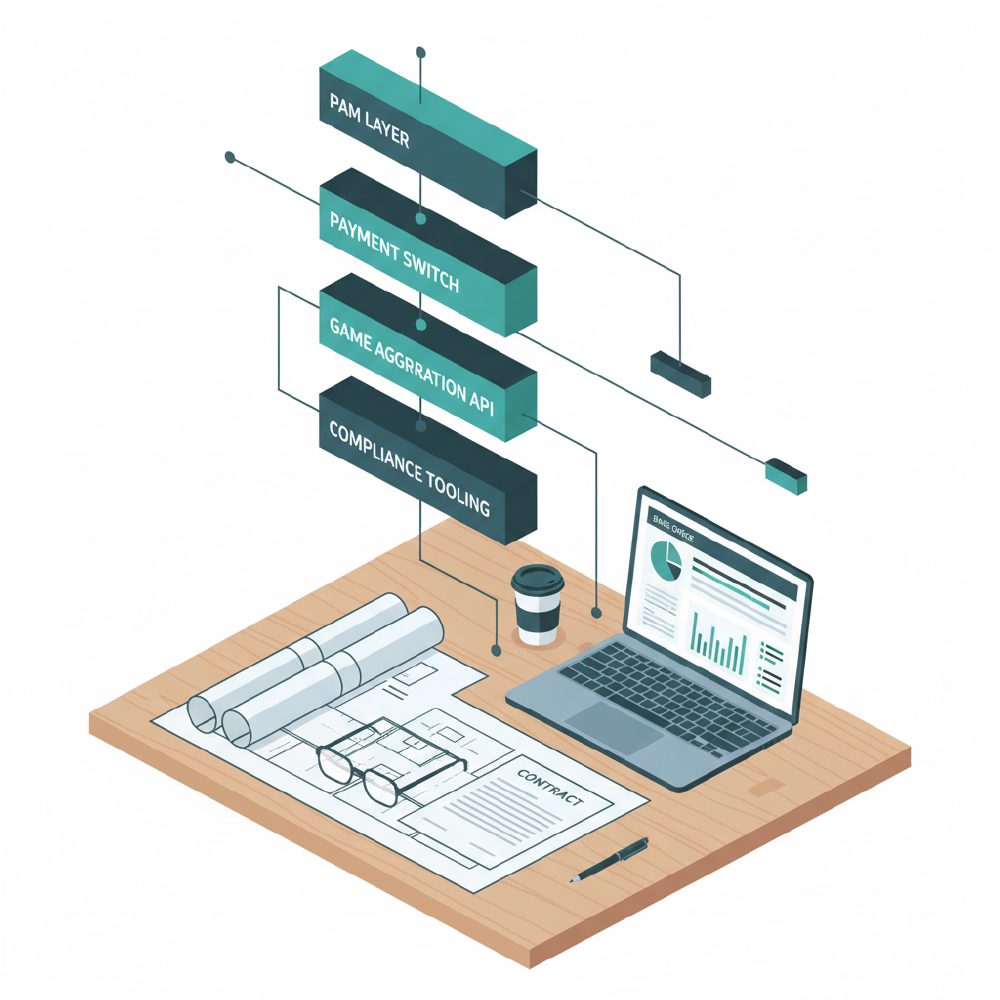
When operators say they want to 'build a casino,' they usually mean assembling a stack, not writing a platform from zero. The core platform handles player accounts, session management, the bonus and promotion engine, affiliate tracking, and the operator back-office. That alone is a multi-year engineering project if you go custom. On top of it sit game aggregation (connecting to studios like Pragmatic Play, Evolution, or Hacksaw Gaming), a payment switch, fraud and AML screening, and a CRM layer. Each of these has a specialist vendor market.
The distinction matters because your budget allocation looks completely different depending on the path. A white-label operator might spend 60% of year-one costs on marketing and payment deposits, while a custom-build operator is spending the same period paying a dev team. Neither is wrong — they're solving different problems. What's wrong is treating 'software development' as a single line item without understanding which layers you're actually procuring.
Regulatory requirements also shape the technical scope directly. An MGA-licensed operator needs a certified RNG, a self-exclusion integration (GAMSTOP in the UK, national registries elsewhere), and specific responsible gambling UI elements — all of which must be built or configured before go-live. A Curaçao operator has a lighter technical compliance checklist today, though the 2023 Curaçao Gaming Authority overhaul is tightening that. US state licenses (New Jersey, Michigan, Pennsylvania) are the most demanding: geolocation enforcement, state-specific self-exclusion databases, and sometimes mandated local data residency.
White-label, turnkey, or custom build — which development path fits your budget?
White-label is the fastest and cheapest entry point but costs the most over time as a revenue share. Turnkey gives you more control and a cleaner exit path but demands more capital upfront. Custom development delivers full ownership and differentiation but requires a $500k+ budget and at least 12 months before you see a live product. Most first-time operators underestimate how quickly white-label fees compound.
White-label platforms — SoftSwiss's BGAMING-powered offering, EveryMatrix's CasinoEngine, Turnkey Casino, and similar — work on a software-as-a-service model. You pay a setup fee (typically $15k–$40k), a monthly minimum (often $5k–$10k), and a revenue share on GGR that ranges from 5% to 15% depending on volume commitments. The vendor handles hosting, platform updates, and in some cases the master license sublicense. You get a branded skin, a content library, and a payment integration that someone else maintains. Time to launch: 4–12 weeks if your content and payment provider agreements are already in place.
Turnkey solutions sit in the middle. Providers like Softgamings, GamingSoft, or Digitain sell you a platform license — you deploy it, you own the instance, and you're not paying perpetual GGR share. Upfront cost is higher: $80k–$250k for the platform license, plus integration and setup work. Total first-year spend including compliance tooling, payment integrations, and a small dev team for customization typically lands between $150k and $500k. Timeline is 3–6 months to a production-ready build. The trade-off is that you're still running on someone else's core architecture, so deep product changes require vendor cooperation.
Custom development means hiring a team — either an in-house engineering squad or an outsourced iGaming software development company like Chetu, Intellectsoft, or a boutique studio — to build your platform from the ground up. Realistic budgets start at $500k for a stripped-down MVP and scale past $2M for a full-featured platform with native mobile apps, a proprietary bonus engine, and a sportsbook module. Timeline is 12–24 months before a stable live product. The business case only holds if you have a genuine product differentiation angle (a novel mechanic, a specific regulated market with no existing vendor support, or a vertical integration play) and the runway to survive a long pre-revenue development phase.
| Path | Upfront Cost | Ongoing Cost | Time to Launch | IP Ownership | Best For |
|---|---|---|---|---|---|
| White-label | $15k–$40k | 5–15% GGR + monthly min | 4–12 weeks | None | First-time operators, low capital, fast market test |
| Turnkey license | $80k–$250k | Annual license + hosting | 3–6 months | Partial (your data, not the core) | Operators wanting control without full custom risk |
| Custom build | $500k–$2M+ | Engineering team + infra | 12–24 months | Full | Differentiated products, large operators, specific regulated markets |
How much does iGaming software development cost in 2026?
Total first-year cost for a white-label casino sits between $100k and $300k when you include setup, payment deposits, compliance tooling, and marketing. A turnkey build runs $200k–$600k. Custom development rarely comes in under $700k all-in for year one. These are ranges, not quotes — jurisdiction, game content scope, and payment complexity all move the number significantly.
The figures vendors quote in sales decks are almost always platform-only costs. What they don't show you is the full stack. Payment processing requires upfront deposits with acquirers (often $25k–$100k per processor, and you'll want at least two), plus integration work. KYC and AML tooling from providers like Sumsub, Onfido, or Jumio adds $1k–$5k per month at startup volumes. A responsible gambling suite — session limits, reality checks, self-exclusion — either comes bundled with your platform or needs to be built; budget $10k–$30k if it's not included. Affiliate tracking software (Income Access, MyAffiliates, or similar) is another $500–$2k per month.
Staffing is the hidden multiplier. Even on a white-label, you need someone managing the platform day-to-day, handling player queries, running promotions, and liaising with the compliance team. A lean operation needs at minimum a platform manager, a customer support lead, and a part-time compliance officer. In offshore markets you might outsource this; in regulated EU or US markets you often can't. Factor $150k–$400k annually for a minimal but functional team.
Licensing fees are separate again. A Curaçao sublicense through a master license holder runs $15k–$30k to set up and $5k–$15k per year. An MGA license costs €25k in application fees alone, plus €25k annual supervisory fees, plus the cost of the technical audit. A US state license — New Jersey's CSIE, for example — involves application fees, a background investigation that can cost $50k–$150k in legal and compliance preparation, and ongoing reporting obligations. None of this appears in a platform vendor's pricing sheet.
| Cost Component | White-Label Operator | Turnkey Operator | Custom Build |
|---|---|---|---|
| Platform setup / license | $15k–$40k | $80k–$250k | $500k–$1.5M |
| Payment deposits & integration | $50k–$150k | $50k–$150k | $50k–$150k |
| KYC/AML tooling (yr 1) | $12k–$60k | $12k–$60k | $20k–$80k |
| Licensing & compliance | $20k–$200k | $20k–$200k | $20k–$300k |
| Staffing (lean team) | $150k–$300k | $200k–$400k | $300k–$600k |
| Marketing & player acquisition | $50k–$500k+ | $50k–$500k+ | $50k–$500k+ |
| Total year-one estimate | $300k–$1.2M | $400k–$1.5M | $1M–$3M+ |
What technical components does an online casino software build require?
At minimum, a production-ready online casino platform needs a player account management system, a wallet and transaction ledger, a bonus and wagering requirement engine, a game integration layer (API aggregator or direct RGS connections), a payment switch, KYC/AML hooks, a CMS for promotions, and an operator back-office with real-time reporting. Each of these is a non-trivial engineering surface.
The player account management system (PAM) is the heart of the platform. It handles registration, login, session tokens, KYC status, account limits, and the responsible gambling controls regulators mandate. A robust PAM needs to support concurrent sessions, handle account recovery securely, and log every state change for audit purposes. Off-the-shelf PAM modules from vendors like EveryMatrix or SoftSwiss are mature and well-tested; building one from scratch is a 6–12 month engineering project on its own.
The game integration layer is where most operators feel the most immediate pain. Direct integration with a studio like Evolution Gaming or Pragmatic Play requires signing a commercial agreement, completing a technical integration (typically REST or SOAP APIs with a wallet callback system), and passing the studio's certification process. A game aggregator like Relax Gaming's Silver Bullet, Pariplay, or GAN's Oryx Hub aggregates hundreds of studios behind a single API, which dramatically reduces integration time but adds a layer of revenue share. For a new operator, the aggregator route is almost always the right call — you can add direct deals later once volume justifies the negotiation leverage.
The payment switch deserves more attention than most operators give it during planning. You need to route transactions to the right processor based on card type, geography, and risk profile, handle declined transactions gracefully, support multiple currencies, and reconcile everything against your internal wallet ledger. Providers like Nuvei, Payvision, and Praxis Tech offer casino-specific payment orchestration. Crypto payment processors — CoinsPaid, B2BinPay — are increasingly standard even for fiat-first operators. The integration work here is substantial: plan for 4–8 weeks of engineering time per payment method, and budget for ongoing maintenance as acquirers update their APIs.
Back-office and reporting infrastructure is the component that gets under-specced most often. Operators need real-time GGR dashboards, player-level transaction history, bonus liability tracking, affiliate performance reports, and regulatory reporting exports. If you're on a white-label, this comes with the platform — though the quality varies significantly. If you're building custom, invest properly here: a bad back-office costs you hours every week in manual reconciliation and creates compliance risk when regulators request data exports.
How do you choose the right iGaming software development company?
Evaluate vendors on three things: proven live deployments in your target jurisdiction, a transparent pricing model with no hidden GGR escalators, and a reference list of operators you can actually call. Any vendor that can't give you three live operator references in your market segment is selling you a promise, not a product.
The iGaming software development company market is noisy. There are genuine platform vendors with years of live operator deployments — SoftSwiss, EveryMatrix, Digitain, Softgamings, GamingSoft — and there are development shops that have built one or two casino projects and are marketing themselves as specialists. The difference matters enormously when you hit a compliance deadline or a payment integration breaks at 2am on a Friday. Ask specifically: how many operators are live on your platform today, in which jurisdictions, and can I speak to three of them?
Jurisdiction expertise is non-negotiable. A vendor that has deployed MGA-licensed casinos understands the technical audit requirements, the responsible gambling UI mandates, and the data retention obligations. That same vendor may have no experience with New Jersey's DGE technical standards, which require specific geolocation enforcement mechanisms and state database integrations. Don't assume that 'regulated market experience' transfers across jurisdictions — ask for specifics.
Contract terms are where operators get burned. Watch for: perpetual GGR revenue share with no volume-based reduction schedule; data portability clauses that make it expensive to migrate to a different platform later; exclusivity provisions that prevent you from adding direct game studio integrations; and SLA terms that sound strong but carve out 'scheduled maintenance' windows that happen to coincide with peak traffic. Have a lawyer who understands iGaming contracts review the agreement — not a general commercial lawyer, but someone who has reviewed platform agreements before.
For custom development specifically, evaluate the team's experience with the specific compliance engineering your jurisdiction requires. Building a geolocation enforcement system for a US state license is a different problem from building a self-exclusion integration for GAMSTOP. Ask to see code samples, review their testing methodology, and understand how they handle security audits. PCI DSS compliance for payment handling, penetration testing, and RNG certification (through labs like BMM, GLI, or eCOGRA) all require specialist knowledge that not every development shop has.
How does jurisdiction choice shape your technical architecture?
Your license jurisdiction determines your RNG certification lab, your responsible gambling feature set, your data residency requirements, and in US states, your geolocation enforcement architecture. Get the jurisdiction decision wrong and you're rebuilding core platform components after launch — which is far more expensive than getting it right upfront.
Curaçao is the most permissive technically. The 2023 Curaçao Gaming Authority (CGA) reforms introduced a new licensing framework with stricter AML and player protection requirements than the old sublicense system, but the technical bar is still lower than MGA or any US state. You need an approved RNG (self-certified or lab-certified depending on your games), basic responsible gambling tools, and AML transaction monitoring. Most white-label platforms are already compliant out of the box for Curaçao.
The MGA (Malta Gaming Authority) raises the bar substantially. Technical compliance requires a certified RNG from an approved test lab (BMM, GLI, eCOGRA, iTech Labs), a full responsible gambling feature set including deposit limits, session limits, reality checks, and self-exclusion with a 24-hour cooling-off period, and a technical audit before license issuance. Data must be retained for a minimum period and accessible to MGA auditors. The MGA also mandates specific player fund segregation, which has treasury and banking implications beyond just the technical stack.
US state licenses are the most demanding. New Jersey's Division of Gaming Enforcement (DGE) requires geolocation enforcement that verifies a player is physically within state borders at login and at defined intervals during play — this means integrating a geolocation provider like GeoComply, which has become the de facto standard. Michigan's MGCB and Pennsylvania's PGCB have similar requirements. All three states require integration with their respective self-exclusion databases. Some states mandate that certain data be stored on servers physically located within the US, which has direct infrastructure implications. Budget an additional $100k–$300k in compliance engineering if you're building for a US state license from a platform that wasn't originally designed for it.
What is the realistic timeline for an iGaming software development project?
White-label operators can go live in 4–12 weeks if payment and content agreements are pre-signed. Turnkey builds take 3–6 months. Custom development is 12–24 months for a stable production platform. The single biggest timeline killer across all three paths is payment processing — acquiring bank approvals and payment provider onboarding consistently take longer than any technical development work.
The 4–12 week white-label timeline assumes you walk in with a signed content aggregator agreement, a payment processor already approved for your jurisdiction, and a domain and brand ready. In practice, most operators spend 4–6 weeks just getting payment processing approved — acquiring banks are cautious about new gambling merchants, and the onboarding documentation requirements (business plan, AML policy, source of funds for the initial deposit, director background checks) take time to compile. Start payment conversations before you sign the platform agreement.
For turnkey builds, the critical path is usually the platform configuration and compliance tooling, not core development. The vendor delivers the base platform; your team (or an integration partner) configures the bonus engine, sets up the payment routing rules, connects the KYC provider, and builds the front-end skin. That configuration work is consistently underestimated. Add 4–6 weeks for QA and UAT, and another 2–4 weeks for the technical compliance review if your license requires one. Six months is a realistic median; three months is aggressive and usually involves cutting corners on QA.
Custom builds have the most variable timelines. A well-scoped MVP with a defined feature set and a competent team of 8–12 engineers can ship in 12 months. Scope creep, unclear requirements, and the inevitable compliance engineering surprises push most projects to 18–24 months. The operators I've seen hit 12-month timelines consistently had one thing in common: they locked the MVP scope early and refused to add features until after launch. Everything that sounds like a 'small addition' during development adds weeks to QA and integration testing.
What are the most common and costly mistakes in online casino software development?
The five mistakes I see most often: starting development before confirming a payment processing solution, underspecifying compliance requirements for the target jurisdiction, choosing a platform vendor without exit-path due diligence, underestimating QA and testing time, and building custom when a turnkey solution would have served the business case. Each one has cost operators six figures to fix post-launch.
Payment processing is the number one project killer. I have watched operators spend six months and $300k building a platform, then spend another four months unable to launch because they couldn't get a card processing account approved. Gambling is a high-risk merchant category. Many acquiring banks won't touch it at all. The ones that will — Nuvei, Payvision, Worldpay for Gaming, PaySafe — have onboarding processes that can take 8–16 weeks and may require a local entity, a specific license, or a minimum capitalization. Start this process on day one, not after the platform is built.
Underspecifying compliance requirements is the second killer. Operators often describe their technical requirements in terms of features ('we need a bonus engine, a game lobby, a payment page') without translating their license obligations into technical requirements. Then, three weeks before launch, the compliance team discovers that the RNG hasn't been certified, the self-exclusion integration is missing, or the transaction monitoring system doesn't produce the report format the regulator requires. Fixing compliance gaps on a near-live platform is expensive and stressful. The right approach: translate your license conditions into a technical requirements document before you write a line of code or sign a platform contract.
Vendor lock-in is a slow-burn mistake. Operators sign white-label agreements without checking data portability terms, then discover two years later that migrating their player database to a new platform costs $200k in vendor extraction fees and six months of downtime risk. Before signing any platform contract, ask: what does it cost to leave? What data do I own, in what format, and what is the contractual process for extracting it? If the vendor can't answer this clearly, treat it as a red flag.
How does game content integration work in iGaming software development?
Game content integration connects your platform's wallet system to game studios via API. You can do this through a game aggregator (one API, hundreds of studios, revenue share per game) or via direct studio integrations (better commercial terms at volume, but each integration takes 4–8 weeks). Most operators start with an aggregator and add direct deals as GGR justifies the negotiation leverage.
The technical mechanism is a wallet API: when a player launches a game, the studio's remote game server (RGS) calls your platform's wallet endpoint to debit and credit funds. Your platform needs to handle these callbacks reliably, idempotently (so a network retry doesn't double-debit), and within the latency window the studio requires — typically under 200ms. This sounds straightforward but becomes complex at scale when you're handling thousands of concurrent sessions across dozens of studios with different API specifications.
Aggregators like Pariplay (now part of Aristocrat), Relax Gaming's Silver Bullet program, GAN's Oryx Hub, and SoftSwiss's Game Aggregator give you access to hundreds of studios through a single integration. The commercial model adds a layer of revenue share — typically 1–3% of GGR per game on top of the studio's own rate — but the integration time saving is substantial. For a new operator, the aggregator route is almost always the right call. You get immediate access to a broad content library, the aggregator handles studio certification and compliance, and you can negotiate direct deals with your top-performing studios once you have volume data to support the conversation.
Live casino is a special case. Evolution Gaming dominates this segment and operates differently from standard RNG studios — they run their own live dealer studios and require a direct commercial agreement. Evolution does not distribute through most aggregators (or does so on limited terms). Securing an Evolution agreement as a new, unlicensed operator is difficult; they prioritize established operators with proven volumes. Some white-label platforms include Evolution access as part of the bundle, which is one genuine advantage of the white-label route for operators who want live casino from day one.
How should operators evaluate build-vs-buy for specific platform components?
Buy (or license) anything that is a commodity compliance requirement or a solved technical problem: RNG, KYC/AML, payment processing, affiliate tracking. Build only where you have a specific differentiation thesis that a vendor product cannot deliver. Building a bonus engine from scratch when EveryMatrix's BonusEngine exists is a waste of engineering budget that could fund player acquisition.
The build-vs-buy decision comes up repeatedly during platform development, and the answer is almost always 'buy' for compliance-adjacent components. KYC and AML tooling from Sumsub or Onfido has been battle-tested across thousands of operators and handles the edge cases — document forgery detection, PEP and sanctions screening, ongoing monitoring — that a custom-built solution would take years to get right. The same applies to geolocation (GeoComply is the standard for US markets), responsible gambling tooling (BetBlocker, Gamban integrations, national self-exclusion registries), and affiliate tracking (Income Access, MyAffiliates, Affilka by SoftSwiss).
Where custom development genuinely adds value is in the player experience layer — the game lobby UI, the onboarding flow, the gamification mechanics, the CRM triggers. These are the surfaces that differentiate your brand and drive conversion and retention. A well-designed onboarding flow that reduces friction at registration and first deposit can move conversion rates by 15–30 percentage points. That's worth engineering investment. A custom-built KYC system that does the same thing as Sumsub is not.
The hybrid approach — white-label or turnkey core with custom front-end development — is increasingly the practical choice for operators who want brand differentiation without the full custom-build risk. Platforms like SoftSwiss and EveryMatrix expose APIs that allow significant front-end customization without touching the core platform. You get the stability and compliance coverage of a mature platform with a player experience that doesn't look like every other operator on the same white-label stack.
| Component | Recommendation | Rationale | Vendor Examples |
|---|---|---|---|
| Core PAM / wallet | Buy (white-label/turnkey) | Years of edge-case hardening; compliance-critical | SoftSwiss, EveryMatrix, Digitain |
| RNG | Buy (certified) | Regulator mandates lab certification anyway | BMM, GLI, eCOGRA-certified RNGs |
| KYC / AML tooling | Buy | Fraud patterns evolve; vendor models trained on scale | Sumsub, Onfido, Jumio |
| Payment switch | Buy / integrate | Acquirer relationships are vendor-managed | Nuvei, Praxis Tech, CoinsPaid |
| Game aggregation | Buy | Single API vs. 100+ integrations | Pariplay, Relax Silver Bullet, Oryx |
| Affiliate tracking | Buy | Commodity; not a differentiator | Income Access, MyAffiliates, Affilka |
| Player-facing UI / UX | Build (custom) | Primary brand differentiation surface | In-house or boutique agency |
| Proprietary game mechanics | Build (if justified) | Only if you have a specific IP thesis | Custom RGS development |
What ongoing development and maintenance costs should operators budget for?
Post-launch, budget 15–25% of your initial development cost annually for maintenance, compliance updates, and feature development. Regulators update technical standards, payment providers deprecate APIs, and studios release new integration requirements — all of which generate ongoing engineering work whether you're on a white-label or a custom build.
On a white-label platform, ongoing development costs are largely absorbed by the vendor in exchange for your revenue share — platform updates, security patches, and new compliance features roll out automatically. What you still own is the cost of front-end customization, CRM integrations, new payment method additions, and any bespoke features you've built on top of the platform. Budget $2k–$8k per month for a small development retainer to handle these ongoing needs.
On a custom platform, the maintenance burden is entirely yours. Security patches, dependency updates, infrastructure scaling, and the ongoing compliance engineering as regulators update their technical standards all require a standing engineering team. A lean maintenance team for a mid-size custom platform is typically 3–5 engineers, which at market rates for iGaming-experienced developers runs $300k–$600k per year. This is the cost that operators most consistently underestimate when building the business case for custom development.
Compliance-driven development is the wildcard. When the MGA updates its responsible gambling technical standards, or when a US state adds a new self-exclusion database requirement, you have a mandatory development sprint with a regulatory deadline. These typically arrive with 3–6 months notice. On a white-label, the vendor handles it. On a custom build, you're paying for it. Factor in at least two compliance-driven development cycles per year in your budget planning — each one typically runs 2–6 weeks of engineering time.



Comments
No comments yet, be the first.