iGaming Software Providers: The Operator's Ultimate Guide for 2026
What exactly is an iGaming software provider — and why does the category matter?
An iGaming software provider is any B2B company that supplies technology enabling an online casino or sportsbook to operate — covering the platform engine, game content, payment processing, CRM and regulatory compliance tools. The category matters because no single vendor covers every layer well, and the contracts you sign at launch will govern your cost structure for years.
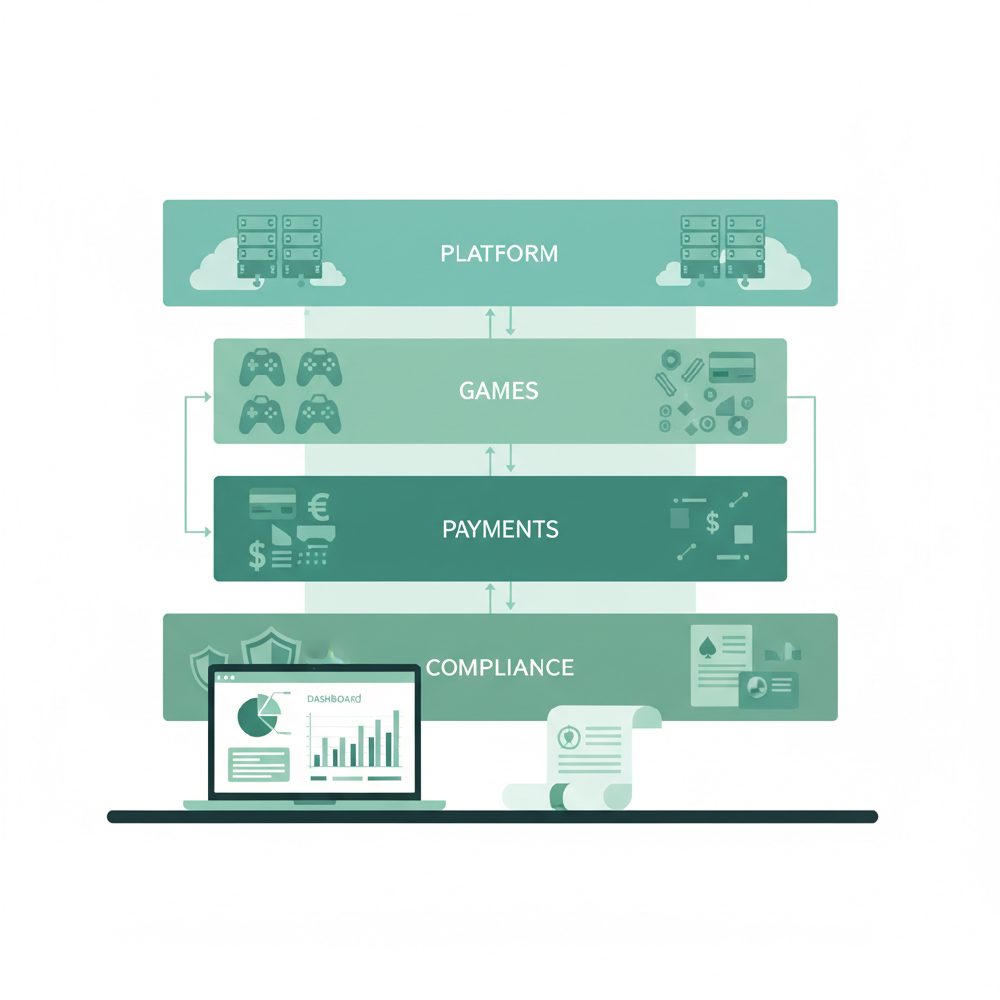
The term gets used loosely in vendor sales decks, which is where operators get into trouble. A 'full-suite iGaming software provider' typically means a platform company that has bolted on a game aggregator, a basic CRM and a payment gateway — but each of those modules may be mediocre compared to a best-in-class specialist. Understanding the stack in layers is the first discipline I push on any founder I advise.
Layer one is the platform itself: the back-office, player account management (PAM), bonus engine, reporting and API layer. Companies like SoftSwiss (now Betby's sister brand), EveryMatrix, Digitain and BetConstruct operate here. Layer two is game content — either sourced through an aggregator (Pariplay, Relax Gaming, Slotegrator) or via direct studio deals with Pragmatic Play, Evolution, NetEnt and others. Layer three is payments: PSPs, crypto processors, local payment methods. Layer four is compliance tooling: KYC/AML providers like Sumsub or Onfido, responsible gambling modules, and regulatory reporting.
Most operators launching their first brand underestimate how much these layers interact. A platform's bonus engine may not support the wagering-requirement logic your chosen jurisdiction demands. Your aggregator's game portfolio may exclude studios that require direct licensing you don't yet hold. Getting clarity on these dependencies before you sign anything saves six-figure remediation costs later.
White-label, turnkey or custom build — which iGaming platform model is right for you?
White-label gets you live fastest (6–12 weeks) under a master license, but you pay a revenue share of 20–40% of GGR and own nothing. Turnkey means you hold the license and the platform is configured for you, costing more upfront but cutting long-run fees. Custom builds are for operators projecting €5M+ annual GGR who need full control and can absorb 12–24 months of development.
White-label is the right answer for operators testing a market with limited capital — typically under $300K available for launch. SoftSwiss's white-label casino product, EveryMatrix's white-label offering and smaller operators like Slotegrator's turnkey package all let you launch under their Curaçao or MGA umbrella license, which eliminates the 3–6 month licensing wait. The trade-off is permanent: you are a tenant on someone else's infrastructure, the platform provider sees your player data, and if they exit the market or change pricing, you have limited leverage.
Turnkey is the middle path I recommend most often for operators who have a clear jurisdiction in mind and a 6–12 month runway. You apply for your own license (Curaçao eGaming, Anjouan, or MGA depending on target markets), then engage a platform provider to configure and deploy the software under your entity. Providers like EveryMatrix, Digitain and BetConstruct offer this model. Upfront costs typically run $150K–$500K depending on scope, but your ongoing fee drops to a flat monthly SaaS charge ($15K–$50K/month at mid-market scale) rather than a GGR percentage.
Custom builds — building a proprietary PAM, bonus engine and front-end from scratch — make economic sense only at significant scale, or in regulated US state markets where platform vendors may not hold the required state-specific supplier license. Several New Jersey and Pennsylvania operators have built proprietary stacks precisely because the approved vendor list is short and licensing a third-party platform adds regulatory complexity. If you're in that position, budget $1M–$3M for an MVP and 18 months minimum before your first bet is placed.
| Model | Time to Launch | Upfront Cost (est.) | Ongoing Fee Structure | License Ownership | Best For |
|---|---|---|---|---|---|
| White-Label | 6–12 weeks | $30K–$100K setup | 20–40% GGR rev-share | Provider holds master license | First-time operators, limited capital, market testing |
| Turnkey | 3–6 months | $150K–$500K | Flat SaaS $15K–$50K/mo | Operator holds own license | Operators with clear jurisdiction, 6–12 month runway |
| Custom Build | 12–24 months | $1M–$3M+ | Internal team + infrastructure | Operator holds own license | Scale operators, US state markets, proprietary differentiation |
Which casino software providers dominate the platform layer in 2025–2026?
SoftSwiss, EveryMatrix and Digitain are the three platforms I see most often in new operator launches across EU and offshore markets. BetConstruct and Pronet Gaming are strong in sportsbook-led builds. The right choice depends on your jurisdiction, your primary vertical (casino vs. sports) and whether you need crypto-native infrastructure.
SoftSwiss (rebranded from its original casino platform arm after the Betby acquisition) remains the dominant white-label and turnkey provider for crypto-friendly offshore operators. Their platform natively supports Bitcoin, Ethereum and stablecoin wallets, and their game aggregator arm gives access to 12,000+ titles. If you're launching a crypto casino under a Curaçao or Anjouan license, they're the default benchmark to price against. Their GGR rev-share for white-label clients typically starts around 30% but is negotiable at volume.
EveryMatrix is the platform I recommend most for operators targeting regulated EU markets — Malta (MGA), Sweden (Spelinspektionen) or Romania (ONJN). Their CasinoEngine aggregator, OddsMatrix sportsbook and Carmen back-office modules are all certified across multiple jurisdictions, which matters enormously when you're dealing with regulators who audit your software stack directly. Their pricing is higher than offshore-focused competitors, but the compliance infrastructure they've already built saves operators months of certification work.
Digitain is worth serious consideration for LATAM and CIS market operators. Their platform has strong local payment integrations for markets like Peru (MINCETUR-regulated), Colombia (Coljuegos) and several Eastern European jurisdictions. BetConstruct and Pronet Gaming both excel when the operator's revenue model is sportsbook-first with casino as a secondary vertical — their trading and risk management tools are genuinely differentiated. For pure-play casino operators, they're less compelling.
How do game aggregators fit into the iGaming software stack — and which ones should operators evaluate?
A game aggregator connects your platform to hundreds of game studios through a single API integration, handling revenue reporting and settlement centrally. The top-tier aggregators — Pariplay, Relax Gaming, Slotegrator and Hub88 — each offer 5,000–15,000 titles. The critical question isn't content breadth; it's which studios are exclusive or restricted, and what the blended rev-share looks like after the aggregator's cut.
The aggregator's business model is straightforward: they take a percentage of the GGR generated by games on their platform, typically 2–5% depending on volume and negotiation. That fee stacks directly on top of the individual game studio's rev-share (usually 10–15% of GGR). Add your platform provider's fee and you can easily reach a blended third-party take-rate of 35–50% of GGR before your own operating costs. Model this before you sign — I've seen operators launch confidently and then discover their effective margin was negative at their projected player volumes.
Pariplay (now part of Aristocrat's digital division) is strong for operators who need certified content across multiple regulated markets simultaneously — their certification footprint covers MGA, UKGC, New Jersey DGE and several others. Relax Gaming is worth evaluating if you want access to their proprietary 'powered by Relax' content alongside third-party aggregation; their in-house titles like Money Train have genuine player demand. Slotegrator is the most accessible option for newer operators — lower minimum volume commitments and a faster integration timeline, though their premium studio coverage is thinner than Pariplay.
Hub88 (part of the SoftSwiss ecosystem) is the natural aggregator choice if you're already on a SoftSwiss platform, since the commercial relationship is pre-negotiated. The risk is vendor concentration — if SoftSwiss has a service issue, your entire stack is affected. For operators who value resilience, maintaining a primary aggregator and a secondary direct deal with two or three high-volume studios (Pragmatic Play and Evolution are the obvious choices) provides a meaningful hedge.
What does iGaming software licensing actually cost — and which jurisdiction fits your business model?
Licensing costs range from roughly $15,000–$35,000 for a Curaçao or Anjouan sublicense up to $25,000–$50,000 annual fees for a Curaçao master license post-2023 reform, and €25,000+ for an MGA B2C license with a six-figure compliance buildout. The jurisdiction choice should follow your target player markets, not your preference for the cheapest option.
Curaçao underwent significant regulatory reform in 2023 under the new National Ordinance on Offshore Games of Hazard (NOOGH). The sublicense model — where operators operated under a master licensee — is being phased out. Operators now need their own Curaçao license directly from the Curaçao Gaming Control Board (GCB), with application fees around $15,000–$20,000 and annual license fees in the $25,000–$35,000 range (figures as of late 2024; the GCB has not yet published final 2025 fee schedules, so treat these as indicative). This reform has pushed some operators toward Anjouan (Comoros), which still operates a faster, lower-cost licensing process — though Anjouan's acceptance by payment processors and software providers is less universal.
The MGA (Malta Gaming Authority) B2C license remains the gold standard for operators targeting EU players who want a credible, widely recognized license. Application fees are approximately €25,000, annual compliance fees add another €25,000+, and you'll spend €100,000–€300,000 on compliance infrastructure (AML policies, responsible gambling tools, player verification systems) before you receive approval. Timeline is typically 4–6 months. The MGA license is accepted by virtually every major payment processor and game studio, which is its primary operational advantage.
For US operators, the licensing landscape is fragmented by state. New Jersey (DGE), Pennsylvania (PGCB), Michigan (MGCB) and Connecticut (CGSB) each require separate operator licenses, and your software providers must also hold state-specific supplier licenses. This is where the 'just use a white-label' approach breaks down entirely — most offshore white-label providers are not approved suppliers in US regulated states. Budget $500K–$2M for a single-state US launch when you factor in licensing, compliance, responsible gambling infrastructure and the required geolocation systems.
| Jurisdiction | Regulator | Est. Application Fee | Est. Annual Fee | Timeline | Best For |
|---|---|---|---|---|---|
| Curaçao (post-reform) | Curaçao GCB | $15,000–$20,000 | $25,000–$35,000/yr | 3–5 months | Offshore/crypto operators, LatAm, Asia-facing |
| Anjouan (Comoros) | AICF | $10,000–$15,000 | $10,000–$15,000/yr | 4–8 weeks | Budget offshore launches; limited PSP acceptance |
| Malta (MGA) | MGA | €25,000 | €25,000+/yr | 4–6 months | EU-facing operators, premium brand positioning |
| Isle of Man (GSC) | GSC | £5,000 app | £35,000+/yr | 4–6 months | UK-adjacent, B2B software licensing |
| US States (e.g. NJ, PA) | DGE / PGCB | $100,000–$500,000+ | Variable + tax | 12–24 months | US market entry; requires state-specific supplier approvals |
How should operators structure the payment stack — and what do iGaming software providers actually deliver here?
Most platform providers offer a built-in payment gateway with 10–30 pre-integrated PSPs, but 'pre-integrated' rarely means 'pre-approved for your jurisdiction.' Operators need to negotiate PSP relationships independently, budget for rolling reserves of 5–10% held 90–180 days, and build redundancy into the stack from day one.
The payment layer is where operator margins get quietly destroyed post-launch. A platform provider will show you a list of 40 payment methods in their sales deck; in practice, 15 of those require separate merchant account applications, 10 are only available in specific jurisdictions, and 5 have processing fees that make them economically unviable for your average deposit size. I always tell operators to ask their platform provider for a list of payment methods that are live, tested and available in their specific target market — the answer is usually much shorter than the marketing material implies.
For offshore operators (Curaçao, Anjouan), getting a traditional card-processing relationship is genuinely difficult. Visa and Mastercard's MCC 7995 (gambling) classification means most acquiring banks require significant reserves and charge 3.5–6% processing fees. Crypto payment processors — CoinsPaid, B2BinPay, TripleA — have become a practical necessity for many offshore operators, not just a nice-to-have. CoinsPaid integrates natively with SoftSwiss platforms; for others, the API integration is typically 2–4 weeks of development work.
Rolling reserves are the cash-flow killer that operators routinely underestimate. A PSP holding 8% of your monthly processing volume for 180 days means that if you process $1M in your first six months, $80,000 is locked up. At $5M processed, that's $400,000 in unavailable capital. Build this into your working capital model before you launch, not after your first reserve notice arrives. Alternative payment methods — local bank transfers, e-wallets like Skrill and Neteller (for markets where they operate), and regional solutions like PIX in Brazil or PSE in Colombia — can reduce card processing dependency and improve conversion rates meaningfully in specific markets.
What should operators look for in an iGaming platform's back-office and CRM capabilities?
The back-office is where your team will live every day — and most operators only discover its limitations after launch. Prioritize a bonus engine that handles complex wagering logic natively, real-time player segmentation for CRM campaigns, and fraud/risk tooling that doesn't require manual intervention at scale. Weak back-office tooling costs you more in staff overhead than the platform savings are worth.
Bonus engine flexibility is the most commonly underestimated requirement. Regulators in markets like Sweden, the UK and Germany impose strict wagering requirement caps and bonus eligibility rules — your platform's bonus engine must enforce these programmatically, not manually. EveryMatrix's Carmen back-office handles multi-jurisdictional bonus logic reasonably well; some cheaper platforms require custom development work every time you want to change a bonus structure, which creates both cost and compliance risk.
CRM and lifecycle marketing tooling varies enormously across platforms. Some providers have built genuinely capable segmentation and campaign tools (BetConstruct's back-office has solid lifecycle automation); others offer basic cohort reporting and expect you to export data to a third-party CRM like Salesforce or Optimove. If retention marketing is central to your strategy — and it should be — clarify exactly what the platform's native CRM can do before you sign, and budget for a third-party integration if it's insufficient.
Fraud and risk management deserves more attention than most operators give it during vendor selection. Bonus abuse, multi-accounting and payment fraud are immediate problems at launch, not hypothetical future concerns. Ask platform providers specifically about their velocity rules engine, device fingerprinting integrations and chargeback management workflow. Platforms that integrate natively with fraud tools like Featurespace, Sardine or even basic IP/device intelligence providers will save you significant manual review time in the first 90 days of operation.
How are iGaming software providers adapting to the 2025–2026 regulatory environment?
The regulatory direction globally is toward stricter KYC, mandatory responsible gambling tools, and tighter control over bonus marketing. The best platform providers are embedding these compliance requirements into their core product rather than treating them as add-ons. Operators who choose platforms that lag on compliance tooling will face remediation costs that dwarf any upfront savings.
The Curaçao reform is the most operationally significant regulatory change for offshore operators since the original licensing framework was established. The new GCB requires operators to implement certified RNG testing, maintain player fund segregation, and deploy responsible gambling tools including deposit limits, self-exclusion and reality checks. Platform providers who served the old sublicense model are scrambling to update their compliance modules; some are ahead of this, others are not. Ask any platform vendor specifically whether their product is certified under the new Curaçao framework — not whether it will be, but whether it is today.
In regulated EU markets, the trajectory is clear: Germany's GlüNeuRStV (State Treaty on Gambling) imposed €1 stake limits on slots and mandatory monthly deposit caps, forcing platform providers to build jurisdiction-specific game configuration layers. Sweden's Spelinspektionen has become increasingly aggressive on bonus marketing restrictions. MGA-licensed operators face enhanced AML source-of-funds requirements that are pushing KYC provider integrations (Sumsub, Onfido, Jumio) from optional to mandatory. Platforms that have these integrations pre-built are meaningfully more valuable than those requiring custom API work.
On the US side, the state-by-state regulatory patchwork continues to evolve. New York's potential online casino legalization (which has been debated since 2022 without resolution as of early 2025) would be the largest single market opening in iGaming history — but it would require platform providers to obtain DGE-equivalent state supplier licenses, a process that takes 12–18 months. Operators considering a US strategy should be evaluating which platform vendors are already investing in US state supplier certifications, because that list is shorter than the general market roster suggests.
What are the real total costs of launching with an iGaming software provider in 2026?
A realistic offshore white-label launch runs $80,000–$200,000 all-in for the first year. A turnkey launch with your own Curaçao license runs $300,000–$700,000. A regulated EU (MGA) launch rarely comes in under $500,000 in year one. These figures include licensing, platform fees, game content, payments setup and a minimal marketing budget — the number operators most often underestimate.
Let me break down a realistic white-label offshore launch budget because vendor sales decks never do this honestly. Platform setup fee: $30,000–$60,000. Curaçao license (new direct model): $35,000–$50,000 first year. KYC/AML provider setup: $5,000–$15,000. Payment processing setup (PSP applications, integration work): $10,000–$20,000. Website design and localization: $15,000–$30,000. Initial working capital for rolling reserves: $50,000–$100,000. That's $145,000–$275,000 before you spend a dollar acquiring a player. Then your ongoing platform GGR rev-share of 25–35% means that at $200,000 monthly GGR, you're paying $50,000–$70,000/month to the platform provider alone.
The turnkey model changes the math significantly at scale. Higher upfront ($150,000–$300,000 for platform configuration plus licensing), but your ongoing fee drops to a flat SaaS charge. At $500,000 monthly GGR, the difference between a 30% rev-share and a $30,000/month flat fee is $120,000 in retained margin every month. The break-even point on the higher upfront turnkey investment is typically 6–12 months of operation at meaningful GGR — which is why I push operators with genuine conviction about their market opportunity toward the turnkey model from the start.
The cost operators most consistently underestimate is player acquisition. iGaming CPAs in competitive markets run $200–$600 per depositing player depending on channel and geography. At a $300 CPA and a 3% conversion rate from click to deposit, you're spending $10,000 in ad spend to acquire 33 depositing players. If your average player LTV is $150, you're underwater before you've paid your platform fee. The software stack is only as valuable as the economics of the player base it serves — model the unit economics before you finalize your platform budget.
How do you evaluate and shortlist iGaming software providers without getting burned by vendor demos?
The demo environment is always polished. The production environment is where you discover the real product. Require a sandbox API environment with test credentials before signing, ask for three operator references in your specific jurisdiction, and get the full contract — not the term sheet — reviewed by an iGaming-specialist lawyer before you commit.
The vendor demo problem is universal in B2B software, but it's particularly acute in iGaming because the demo casino always has perfect uptime, instant payment processing and a flawless bonus engine. Ask the sales team to show you the back-office reporting in a live operator environment — not a demo environment. Ask specifically about their SLA for platform downtime and what compensation operators receive when SLAs are breached. Ask about their incident history over the past 12 months. If they deflect or can't answer, that tells you something.
Reference checks are non-negotiable. Ask for operators in your specific target jurisdiction, not their flagship clients in different markets. An operator running successfully on EveryMatrix in Malta will have a completely different experience than an operator trying to use the same platform for a Colombia Coljuegos-regulated launch. The compliance certification, payment integrations and local support infrastructure can vary dramatically by market. When you call references, ask specifically: what broke in the first 90 days, how long did it take to fix, and what do you wish you'd known before signing?
Contract review is where I see operators cut corners most dangerously. iGaming platform contracts routinely include clauses that give the provider access to your player data for their own marketing purposes, right of first refusal on acquisition, and termination clauses that leave you with minimal data portability. An iGaming-specialist lawyer (not a general commercial lawyer) reviewing the contract costs $3,000–$8,000 and can identify provisions that would cost you ten times that to remediate post-launch. It's the most consistently high-ROI spend in the pre-launch phase.





Comments
No comments yet, be the first.