Online Casino Software Price: What You Really Pay in 2026
What does online casino software actually cost in 2026?
The honest answer is that 'online casino software price' is a bundle of at least six separate cost lines, not a single figure. A bare-bones white-label can start around $15,000 in setup fees, but a realistic first-year budget for a compliant, commercially viable operation — including platform, games, payments, licensing, and operations — runs $150,000 to $400,000 depending on jurisdiction and ambition.
Every vendor pitch deck I've seen since 2013 leads with the setup fee because it's the smallest number on the page. What they don't headline is the revenue share, the game aggregator cut, the payment processing margin, the compliance costs, and the ongoing operational overhead. When you stack all of those together, the economics look very different from slide one.
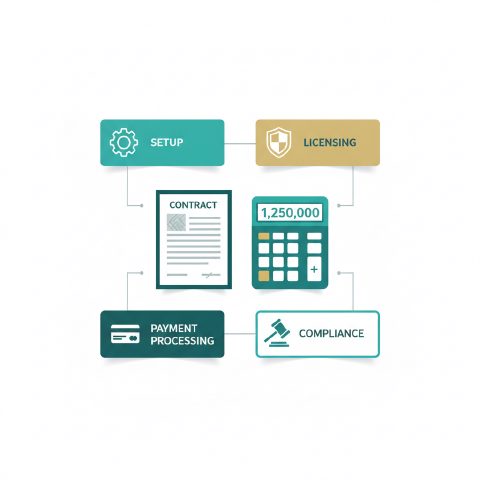
The cost structure breaks down into roughly six layers: (1) the casino platform itself, (2) game content licensing, (3) payment processing infrastructure, (4) the gambling license, (5) KYC/AML and compliance tooling, and (6) operations — support, hosting, and marketing. Each layer has its own pricing model and its own surprises. The sections below go through each one with real figures where I can give them and honest uncertainty flags where I can't.
One framing note before we get into specifics: the right question isn't 'what is the cheapest software?' It's 'what does it cost to build a business that can actually retain players and survive a regulator audit?' Those are very different budgets. I've watched operators launch on shoestring deals, hit their first chargeback spike, and find out their PSP agreement had a rolling 10% reserve — wiping out three months of working capital. The cost conversation has to include those scenarios.
White-label vs. turnkey vs. custom build: how does the pricing model change?
White-label is the lowest upfront cost but the highest ongoing rev-share, typically 25–45% of GGR going back to the platform provider. Turnkey solutions flip that ratio: you pay $80,000–$250,000 to license or own the software, then keep a larger share of revenue. Custom builds start at $300,000+ and take 12–24 months but give you full ownership and zero ongoing software rev-share.
White-label platforms like those offered by SoftSwiss, EveryMatrix, or Digitain bundle everything — platform, back-office, sometimes a game aggregator and payments — under one commercial agreement. The appeal is speed: a credible white-label can go live in 8–16 weeks. The cost is that the platform provider sits between you and your revenue forever. A 35% rev-share sounds manageable at $50,000 GGR per month; at $500,000 GGR per month it's a $175,000 monthly fee to a vendor who did the work three years ago.
Turnkey deals, sometimes called 'licensed software' or 'B2B platform licenses,' let you run the software under your own brand with a one-time or annual license fee rather than a perpetual rev-share. EveryMatrix's standalone modules, SBTech (now part of DraftKings' tech stack), and several Eastern European boutique studios sell this way. The upfront number is real — expect $80,000–$250,000 depending on feature set — but the ongoing cost drops to a flat SaaS fee plus support, often $5,000–$15,000 per month. For operators projecting above $200,000 GGR monthly within 18 months, the math usually favors turnkey over white-label.
Custom builds are a different conversation entirely. You're hiring a development team (in-house or agency), building integrations from scratch with game studios and PSPs, and absorbing all the QA and compliance engineering cost yourself. The floor is around $300,000 and 12 months; most realistic projects land at $500,000–$1.2M over 18–24 months. The operators who benefit are those with genuine long-term volume projections, a specific product differentiation that off-the-shelf platforms can't deliver, or a regulatory requirement (some US state licenses effectively mandate proprietary systems). For most first-time operators, custom is a trap — you spend your entire runway on software before acquiring a single player.
| Model | Typical Setup Cost | Ongoing Platform Cost | Time to Launch | Best For |
|---|---|---|---|---|
| White-Label (e.g. SoftSwiss, EveryMatrix) | $15,000–$50,000 | 25–45% of GGR | 8–16 weeks | First-time operators, fast market entry |
| Turnkey / Licensed Platform | $80,000–$250,000 | Flat $5,000–$15,000/mo | 16–30 weeks | Operators with 18-month volume confidence |
| Custom Build | $300,000–$1,200,000+ | Internal dev + infra costs | 12–24 months | High-volume, differentiated product plays |
What do game content and aggregator fees add to the iGaming software cost?
Game content is almost always the second-largest cost line after the platform rev-share, and it's the one operators most consistently underestimate. A game aggregator like Relax Gaming Hub, SoftSwiss Game Aggregator, or EveryMatrix's CasinoEngine charges 10–20% of GGR from game content — stacked on top of whatever your platform provider takes.
Here's the math that surprises most new operators: if your white-label platform takes 35% of GGR and your game aggregator takes 15%, you're at 50% of gross gaming revenue before you've paid a single staff member, a PSP, or a compliance officer. That's not unusual. It's actually typical for a mid-tier white-label operation in year one.
Direct studio deals — going directly to Pragmatic Play, Evolution, or NetEnt rather than through an aggregator — can reduce the content cost to 8–12% of GGR, but they come with minimum monthly guarantees ($5,000–$30,000 per studio depending on the provider) and integration work that aggregators handle for you. Evolution's live casino is a particular case: it's almost always a direct deal, with rev-share in the 12–18% range and a significant minimum commitment. No aggregator bundles it at a meaningful discount.
If you're on a white-label platform that includes an aggregator as part of the package — which SoftSwiss and EveryMatrix both do — read the contract carefully to understand whether the aggregator fee is included in the platform rev-share or charged separately. I've seen operators sign white-label deals believing the 30% rev-share covered everything, only to discover the game content was billed as an additional 12% on top. The combined 42% wasn't in the sales pitch.
For operators targeting specific markets, content mix matters financially. A LATAM-focused casino leaning on slots from Pragmatic Play and Hacksaw Gaming will pay differently than a live-casino-heavy European brand where Evolution dominates the GGR. Model your content cost against your projected game mix before signing any platform deal.
How much does a gambling license cost, and how does jurisdiction affect the total bill?
Licensing is the most variable cost line in the entire budget. Curaçao eGaming (now operating under the new Curaçao Gaming Control Board framework as of 2023–2024) runs roughly $15,000–$30,000 in year-one fees. An MGA license in Malta can exceed $50,000 before approval. US state licenses — New Jersey, Pennsylvania, Michigan — are a different universe, with application fees, compliance costs, and bonding requirements that routinely push past $500,000.
Curaçao is still the most common offshore starting point for new operators because of its relative speed (3–5 months for a new license under the revised framework) and cost. But the 2023 regulatory overhaul introduced stricter AML requirements, mandatory local substance, and a more rigorous technical audit process. Operators who got licensed in 2019 on a sub-license arrangement are facing a genuinely different compliance burden today. Budget $15,000–$30,000 for the license itself, plus $10,000–$25,000 for local corporate setup, a registered agent, and the technical certification your platform needs to pass the CGCB audit.
Anjouan (Comoros) has emerged as an alternative offshore option, with lower initial costs (sometimes under $10,000) and faster processing, but it carries less market credibility with payment providers and players. If your target market is Western Europe or regulated LATAM, Anjouan will create friction with PSPs that Curaçao doesn't. The cost saving is real; the commercial trade-off is also real.
MGA Malta is the gold standard for European operators. Application fees, compliance preparation, and legal costs mean you should budget $50,000–$100,000 to get through the door, plus a €25,000 annual license fee and ongoing compliance overhead. The payoff is access to Tier-1 payment providers, better player trust signals, and the ability to operate in several EU markets. For operators with serious European volume projections, MGA pays for itself. For a startup testing the market, it's often premature.
US state licenses are in a completely different cost category. New Jersey's iGaming license requires a 'transactional waiver' or full license, partnership with a land-based casino, and compliance infrastructure that typically costs $500,000–$2M+ before you're live. Pennsylvania and Michigan are similarly demanding. If you're building toward the US market, the software cost conversation is almost secondary to the regulatory and partnership cost.
| Jurisdiction | Year-One License Cost (approx.) | Timeline to Approval | Key Trade-offs |
|---|---|---|---|
| Curaçao eGaming (CGCB) | $15,000–$30,000 | 3–5 months | Widely accepted offshore; revised 2023 framework adds compliance burden |
| Anjouan (Comoros) | $8,000–$15,000 | 4–8 weeks | Low cost, fast; limited PSP acceptance, lower player trust |
| MGA Malta | $50,000–$100,000 (setup) | 6–12 months | EU gold standard; high cost, high credibility, Tier-1 PSP access |
| Isle of Man / Gibraltar | $40,000–$80,000 | 6–10 months | Strong brand; good for UK/EU players, complex compliance |
| US State (NJ, PA, MI) | $500,000–$2M+ | 12–24+ months | Massive compliance burden; requires land-based partner in most states |
What does payment processing actually cost an online casino operator?
Payment processing is where iGaming software cost estimates fall apart most dramatically. PSP fees for casino merchants run 3–8% per transaction — two to three times what an e-commerce business pays. Add setup fees ($5,000–$20,000 per processor), rolling reserves (5–10% held for 90–180 days), and chargeback liability, and you can have $50,000–$150,000 tied up in payment infrastructure before your first real player deposits.
The casino industry is a high-risk merchant category for every major payment network. Visa and Mastercard's rules around gambling transactions mean most mainstream acquirers won't touch you, which pushes operators toward specialist iGaming PSPs — companies like Payvision, Nuvei, Praxis Cashier, and a rotating cast of smaller processors. These providers know their leverage and price accordingly. Transaction fees of 4–6% on card deposits are standard; some processors charge 7–8% for new operators without volume history.
Rolling reserves are the cash-flow killer nobody discusses in the sales process. A typical iGaming merchant agreement includes a 5–10% rolling reserve held for 90–180 days. On $500,000 in monthly card deposits, that's $25,000–$50,000 per month being withheld and returned six months later. In your first year, you're essentially funding a reserve account that grows with your volume. Model this in your working capital plan or you will run out of cash at exactly the moment your business is growing.
Crypto payments have changed this calculus for some operators. Processing fees on Bitcoin, Ethereum, and stablecoin transactions are dramatically lower (often under 1%), there are no chargebacks, and no reserve requirements. Platforms like CoinsPaid or BitPay for Business integrate with most iGaming platforms. The trade-off is player reach — crypto still represents a minority of depositing players in most markets, though in some offshore and LATAM segments it's 30–40% of volume. Operators launching in 2026 who ignore crypto are leaving margin on the table.
Beyond per-transaction costs, budget for a payment orchestration layer if you're running multiple PSPs (which you should — single-PSP dependency is an operational risk). Tools like Praxis Cashier or in-house routing logic add cost but dramatically improve deposit conversion rates. A 5% improvement in deposit conversion is worth more than the orchestration tool costs in almost every scenario I've modeled.
What hidden costs do operators discover after signing the platform contract?
The costs vendors reliably omit from the initial pitch include: KYC/AML tooling ($1,000–$5,000/month), responsible gambling compliance software, customer support infrastructure, hosting and CDN fees, affiliate platform costs, and the ongoing technical integration work that every 'plug-and-play' platform still requires. These line items routinely add $15,000–$40,000 per month to operational overhead.
KYC and AML compliance is non-negotiable under every serious jurisdiction, and it's not free. Providers like Jumio, Onfido, or Sum&Substance charge per-verification — typically $1.50–$4.00 per check depending on volume and document type. At 1,000 new player verifications per month, that's $1,500–$4,000 before you've done any enhanced due diligence on high-value players. Add a transaction monitoring tool (ComplyAdvantage, Napier, or similar) and you're at $2,000–$6,000 per month just for compliance infrastructure.
Responsible gambling (RG) tooling is increasingly a license condition, not a nice-to-have. Self-exclusion integrations (GAMSTOP in the UK, national registers in regulated EU markets), deposit limit enforcement, reality check prompts, and affordability checks all require either platform-level features or third-party integrations. Some platforms include basic RG tools; most charge extra for the full suite or require you to integrate a specialist provider. Budget $500–$2,000 per month and allocate engineering time for the integrations.
Customer support is another line that gets waved away with 'we'll handle it ourselves.' A 24/7 live chat operation for a casino with meaningful player volume requires at minimum 4–6 support agents across shifts, plus a team lead and QA process. Outsourced iGaming support providers charge $8–$15 per agent-hour. At 4 agents, 24/7, you're at roughly $20,000–$35,000 per month. This is not optional — slow support is a direct driver of chargeback rates and player churn.
Affiliate platform costs are often ignored until marketing strategy kicks in. NetRefer, Income Access (now part of Paysafe), or MyAffiliates charge $500–$2,000 per month for platform access. More importantly, affiliate commissions in iGaming run 25–45% of net revenue — which stacks on top of all the other rev-share lines already discussed. A new operator running white-label with game aggregator fees, paying affiliates, and absorbing PSP costs can easily find themselves with 80%+ of GGR committed before operating costs. Model this before you sign anything.
How do iGaming software costs compare across different operator sizes and markets?
A micro-operator launching offshore with a white-label targeting crypto players can get to market for $80,000–$120,000 all-in. A mid-market operator entering a regulated EU market realistically needs $300,000–$600,000 in year one. A US-facing operator in a licensed state is looking at $1M–$3M before meaningful revenue. The market you target determines the cost floor more than any other variable.
The offshore crypto casino segment has the lowest barrier to entry in 2026. A white-label from a provider like SoftSwiss or Betsoft's turnkey offering, a Curaçao or Anjouan license, crypto-first payment stack via CoinsPaid, and a lean ops team can be assembled for $80,000–$120,000 if you're disciplined. The trade-off is market ceiling — crypto-first offshore casinos have a smaller addressable player base and face increasing payment friction as regulators tighten offshore access in major markets.
A regulated European operation — say, targeting Germany's newly licensed market under the Gemeinsame Glücksspielbehörde der Länder (GGL) or Sweden under Spelinspektionen — requires an MGA or equivalent license, full AML/KYC compliance infrastructure, localized responsible gambling tools, and payment providers that can handle SEPA and local payment methods. The year-one cost realistically sits at $400,000–$700,000. The upside is access to a large, high-value player base with established payment infrastructure. The downside is the regulatory overhead never gets cheaper.
LATAM markets are increasingly attractive and increasingly complex. Colombia (Coljuegos), Peru (MINCETUR), and Mexico (SEGOB) all have distinct licensing regimes, local payment requirements (PSE in Colombia, PagoEfectivo in Peru, SPEI in Mexico), and language/content localization demands. A properly licensed LATAM operation typically costs $200,000–$500,000 to establish, with the license itself being a smaller fraction than the local infrastructure and compliance work. Brazil's market, now formally regulated under the Secretaria de Prêmios e Apostas (SPA/MF) framework, is attracting serious operator investment — but licensing costs and local partner requirements are still being defined as of early 2026.
| Operator Profile | Platform Model | Target Market | Estimated Year-One Cost |
|---|---|---|---|
| Micro / Startup | White-label (SoftSwiss, Digitain) | Offshore / Crypto-first | $80,000–$150,000 |
| Mid-Market | White-label or Turnkey | Regulated EU (MGA, GGL) | $350,000–$700,000 |
| Mid-Market | White-label or Turnkey | LATAM (Coljuegos, MINCETUR) | $200,000–$500,000 |
| Established Operator | Turnkey or Custom | US State (NJ, PA, MI) | $1,000,000–$3,000,000+ |
What questions should operators ask vendors before signing a software contract?
The five questions that expose the real iGaming software cost are: (1) Is the game content fee included in or separate from the platform rev-share? (2) What are the minimum monthly guarantees? (3) Who owns the player data? (4) What does migration off your platform cost? (5) What technical certifications does your platform hold, and which jurisdictions require additional audits? Vendors who hedge on any of these deserve a harder follow-up.
The game content fee question alone has saved operators I've worked with from six-figure surprises. When a white-label provider quotes 30% rev-share, that number is almost always the platform fee only. The game aggregator layer — which may be the same company's product or a third-party integration — is typically billed separately at 10–20% of GGR from game content. Ask explicitly: 'What is the all-in percentage of GGR I will pay your company and any affiliated entities once I am live?' Get it in writing.
Minimum monthly guarantees are the second-biggest trap. Direct studio deals with Pragmatic Play, Evolution, or Microgaming often include a minimum monthly fee — $5,000–$30,000 depending on the studio — regardless of your actual GGR. If you launch and player acquisition is slower than projected, you're paying those minimums out of pocket. Some white-label platforms also include minimum fees that kick in after a grace period. Read every 'minimum' clause in every contract before signing.
Player data ownership is a legal and commercial issue that becomes critical if you ever want to switch platforms or sell the business. Some white-label agreements give the platform provider co-ownership or primary ownership of your player database. That's a deal-breaker for any operator building toward an exit or a platform migration. Insist on clear contractual language that the player data is yours, stored in a way you can export, and that the platform provider has no right to market to your players independently.
Migration costs are the exit fee nobody discusses at signing. I've seen operators trapped on underperforming platforms because the migration clause required 12 months' notice, a six-figure exit fee, or both. Ask for the migration and termination terms before you sign the initial agreement, not when you're already unhappy and negotiating from a weak position.
How do ongoing operational costs affect the long-term ROI of casino software?
The software cost is a one-time or annual number; the operational cost is forever. Monthly operational overhead for a mid-size casino — support, compliance, hosting, payment processing, affiliate commissions, and platform fees — routinely runs $60,000–$150,000 before marketing spend. Understanding the cost structure at scale is what separates operators who build equity from those who generate revenue but never profit.
The unit economics of online casino operations improve with scale, but not as dramatically as in pure SaaS businesses because the rev-share and transaction cost lines scale with revenue rather than being fixed. A white-label operator at $100,000 GGR per month might be paying 35% platform rev-share ($35,000), 15% game content ($15,000), 5% PSP fees ($5,000), and $20,000 in fixed operational costs — leaving $25,000 before marketing, staff, and tax. That's a 25% EBITDA margin before customer acquisition cost, which is thin.
At $500,000 GGR per month, the fixed costs become a smaller percentage, but the rev-share lines scale proportionally. The operator above would now be paying $175,000 in platform fees, $75,000 in game content, $25,000 in PSP fees, and perhaps $30,000 in fixed ops — leaving $195,000 before marketing. That's a 39% margin before CAC, which is more workable. The implication is clear: the white-label model has a profitability floor that only becomes viable above a certain volume threshold. Below that threshold, you're essentially subsidizing the platform provider's margins.
This is why the turnkey vs. white-label decision is fundamentally a volume bet. If you're confident you'll reach $300,000+ GGR monthly within 18 months, paying $150,000–$250,000 upfront for a turnkey platform that takes a flat $8,000/month instead of 35% of GGR is almost always the better financial decision. If you're uncertain about volume — which most honest first-time operators should be — the white-label's lower upfront cost is the appropriate risk trade-off, even if the long-term economics are worse.
Tax treatment of casino software costs varies by jurisdiction and operator structure. In most offshore setups, platform fees and rev-share are deductible operating expenses. In regulated markets like the UK or Sweden, the tax structure on GGR (15% in the UK under the Remote Gaming Duty, 18% in Sweden) compounds with software costs to squeeze margins further. Any ROI model that doesn't include the jurisdiction's GGR tax rate is incomplete. I've reviewed operator projections that looked profitable until someone added the UK RGD line — at which point the economics fell apart entirely.
Are there legitimate ways to reduce online casino software costs without sacrificing quality?
Yes — three levers actually move the needle: negotiating rev-share reduction milestones tied to GGR volume, choosing a platform that includes a game aggregator rather than paying both separately, and launching in a lower-cost jurisdiction first to build volume before pursuing more expensive regulated markets. Cost-cutting on KYC, compliance, or player support is a false economy that creates regulatory and chargeback risk.
Volume-tiered rev-share is more negotiable than vendors let on, especially with mid-tier white-label providers who want to win your business. I've negotiated agreements that start at 35% but step down to 28% at $200,000 GGR/month and 22% at $500,000 GGR/month. Those milestones need to be in the contract at signing — you won't get them renegotiated after launch when you have no leverage. The larger providers (SoftSwiss, EveryMatrix) are less flexible because they have pipeline; smaller boutique platforms are often willing to deal on rev-share in exchange for a longer initial term.
Bundled platform-plus-aggregator deals genuinely reduce the total content cost compared to paying both lines separately. SoftSwiss's white-label offering, for example, bundles the game aggregator into the platform agreement, which simplifies the commercial structure even if the headline rev-share looks higher than a platform-only deal. Do the math on total GGR commitment, not headline percentages.
The jurisdictional sequencing strategy — launch offshore (Curaçao) to build volume and product-market fit, then apply for MGA or a regulated EU license once you have revenue to fund the compliance cost — is genuinely sound for operators who aren't targeting markets that require a local license from day one. The risk is that some players and payment providers treat offshore licenses as a negative signal, and you may need to rebuild trust when you migrate to a regulated license. That migration also has a cost: new technical audits, updated terms and conditions, potential player re-verification. Plan for it.




Comments
No comments yet, be the first.