White Label Casino Cost: The Full 2026 Pricing Breakdown Operators Need Before Signing Anything
What does a white label casino actually cost to launch in 2026?
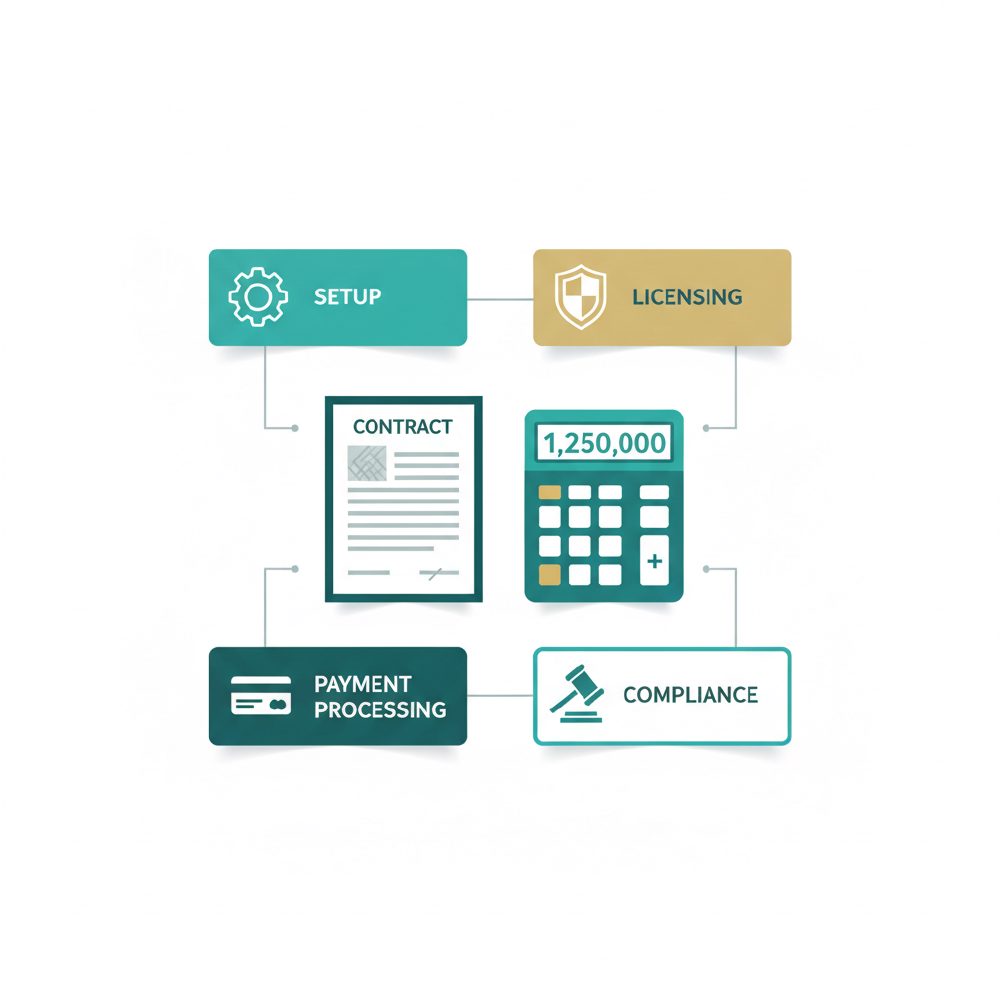
A realistic white label casino launch in 2026 costs between $30,000 and $120,000 in year-one spend when you account for setup fees, licensing, compliance tooling, payment integration and the first few months of platform fees. The vendor's headline setup number — often $15,000–$50,000 — is only the opening act.
The setup fee is what vendors lead with because it's the easiest number to compare. SoftSwiss, EveryMatrix, Turnkey Casino and similar providers pitch white label packages at roughly $15,000–$50,000 depending on the feature tier, game aggregator bundle and level of customisation. That fee covers platform access, a skin build, back-office configuration and a standard game library integration. It does not cover your license, your PSP relationships, your KYC/AML tooling, your responsible gambling software or your CDN and hosting overage costs.
Add a Curaçao Gaming Control Board (GCB) sub-license — the new framework that replaced the old master-license structure — and you're looking at roughly $15,000–$25,000 in first-year licensing costs including the application fee, compliance documentation and the registered agent requirement. Anjouan (GCGC) runs cheaper, often $10,000–$18,000 all-in for year one, though its market acceptance is narrower. MGA licensing is a different category entirely: €25,000 application fee plus compliance infrastructure that pushes first-year costs well past €100,000.
Payment setup is the line item that blindsides most first-time operators. A tier-2 acquiring relationship for a newly licensed offshore operator will charge 5–10% on card transactions, require a rolling reserve of 5–10% held for 180 days, and may charge a $2,000–$5,000 setup fee per PSP. If you want crypto (and most offshore operators do), wallet integration and a crypto payment processor like CoinsPaid or Utorg adds another $1,500–$5,000 in setup. By the time you've assembled a functional payment stack, you've spent $15,000–$30,000 before processing a single deposit.
My honest year-one estimate for a lean but properly built white label operation on a Curaçao or Anjouan license: $60,000–$120,000 total spend before you hit break-even GGR. Operators who budget $20,000 and expect to be live and profitable in 90 days are setting themselves up for a painful mid-launch capital call.
How do white label casino setup fees break down by provider tier?
White label casino providers generally fall into three tiers based on platform maturity, game library depth and support quality. Entry-level packages start around $10,000–$20,000; mid-tier solutions with full aggregator access run $25,000–$50,000; and enterprise or turnkey-adjacent builds with custom features can reach $80,000–$150,000 upfront.
The tier distinction matters because it maps directly to what you're actually getting. Entry-level white label providers — often smaller outfits or resellers of larger platforms — will give you a templated skin, a limited game aggregator (maybe Softgaming or a single-studio deal), basic CRM and a shared back-office. These are fine for testing a market with low capital exposure, but the platform limitations become a ceiling fast. You'll hit walls around bonus engine flexibility, payment method depth and reporting granularity within six months.
Mid-tier providers like SoftSwiss's white label arm, EveryMatrix's white label product or BetConstruct offer full aggregator access (meaning thousands of slots, live tables from Evolution, Pragmatic Live, etc.), a proper bonus engine, affiliate module and dedicated account management. The $25,000–$50,000 setup buys you a platform that can realistically scale. The trade-off is the rev-share: these providers typically take 15–25% of GGR, and that percentage compounds painfully as your operation grows.
Enterprise builds — where a provider like Softswiss or a custom shop builds you a near-turnkey product with unique front-end, proprietary features and API ownership — blur the line between white label and turnkey. Costs here start at $80,000 and regularly exceed $200,000 for the build phase alone. The upside is that you own more of the stack and your rev-share obligations shrink or disappear. The downside is timeline: 6–12 months to launch versus 4–8 weeks for a standard white label.
| Tier | Setup Fee Range | Typical Rev-Share (GGR) | Time to Launch | Best For |
|---|---|---|---|---|
| Entry-level (templated) | $10,000–$20,000 | 25–35% | 2–4 weeks | Market testing, low-budget pilots |
| Mid-tier (full aggregator) | $25,000–$50,000 | 15–25% | 4–8 weeks | Serious launches with growth runway |
| Enterprise / near-turnkey | $80,000–$200,000+ | 5–15% or flat fee | 3–12 months | Operators scaling to $1M+ GGR/month |
What ongoing fees should operators expect after launch?
Ongoing white label casino costs include platform/software fees (often embedded in rev-share), game content fees, payment processing, KYC/AML tooling, hosting, affiliate platform costs and customer support infrastructure. Combined, these typically consume 40–60% of GGR in the first year of operation — a figure most vendor decks never surface.
The rev-share is the dominant ongoing cost and the one operators consistently underestimate. At 20% of GGR, an operator running $200,000 GGR per month is paying $40,000/month — $480,000 per year — to their white label provider. That's before game content fees, which some providers charge separately at 3–8% of GGR on top of the platform rev-share. Read your contract carefully: some providers bundle game fees into the rev-share, others stack them.
KYC and AML tooling is a recurring cost that regulators are increasingly scrutinizing. Sumsub, Shufti Pro and Jumio all offer tiered pricing; expect $0.50–$3.00 per verification depending on volume and document type, plus a monthly platform fee of $500–$2,000. A mid-volume operator doing 2,000 verifications per month can easily spend $3,000–$8,000/month on identity verification alone. Responsible gambling tools — self-exclusion integration with GAMSTOP (UK), or proprietary tools for offshore — add another $500–$2,000/month.
Hosting and CDN costs are minor individually but worth tracking. Most white label providers include hosting in the setup fee but charge overages above a traffic threshold. If you're running aggressive paid acquisition and your CDN costs spike, that can add $1,000–$5,000/month unexpectedly. Affiliate platform licensing (Income Access, MyAffiliates, TUNE) runs $500–$2,000/month depending on the tier, and you'll need this from day one if affiliate traffic is part of your acquisition strategy.
Customer support is the cost nobody budgets for. A white label provider rarely includes live support agents — they provide the platform, not the operation. Outsourced casino support through providers like Intelicare or Helpware runs $8–$15 per agent-hour. A 24/7 multilingual support operation for a small casino requires at least 4–6 agents, which translates to $8,000–$20,000/month. Operators who skip this and rely on email-only support discover quickly that it kills retention.
How does white label casino pricing compare to turnkey and custom builds?
White label is the lowest upfront cost but highest ongoing cost as a percentage of revenue. Turnkey sits in the middle — higher setup, lower rev-share. Custom builds carry the highest initial investment ($300,000+) but the lowest long-term cost per dollar of GGR. The right choice depends entirely on your capital position and 24-month revenue projection.
The core trade-off is time-versus-ownership. White label gets you live in weeks with minimal capital, but you're permanently renting the platform. At 20% rev-share, an operator doing $500,000 GGR/month is handing $100,000/month to the platform provider — $1.2M per year. That's the cost of a custom build every 3–4 months. At scale, white label is the most expensive option by a significant margin.
Turnkey casino solutions — where you license a full platform, own the front-end and typically pay a flat monthly fee rather than a rev-share — make sense once you're confident in your market and have $150,000–$400,000 to invest upfront. Providers like Softswiss's turnkey product, EveryMatrix's full stack or Digitain offer this model. Monthly fees run $10,000–$30,000 flat, which becomes dramatically cheaper than rev-share once you cross ~$150,000 GGR/month.
Custom builds — building on open-source frameworks or commissioning a bespoke platform from a development shop — require $300,000–$1,000,000+ and 12–24 months. The operators who go this route are typically those who've already run a white label, understand the product deeply and are ready to own the tech stack. It's not a starting point; it's an exit from white label dependency.
| Model | Upfront Cost | Ongoing Cost Structure | Time to Launch | Platform Ownership | Recommended GGR Threshold |
|---|---|---|---|---|---|
| White Label | $15,000–$50,000 | 15–35% GGR rev-share | 2–8 weeks | None | $0–$300K/month |
| Turnkey | $150,000–$400,000 | $10,000–$30,000/month flat | 3–6 months | Partial (front-end) | $150K–$1M/month |
| Custom Build | $300,000–$1,000,000+ | Hosting + staff only | 12–24 months | Full | $500K+/month |
What does casino licensing cost on top of the white label fee?
Licensing cost depends entirely on jurisdiction. Curaçao GCB runs $15,000–$25,000 in year one; Anjouan (GCGC) is $10,000–$18,000; MGA starts at €25,000 application fee alone. US state licenses (New Jersey, Michigan, Pennsylvania) are a different universe — multi-year processes costing $500,000+ in compliance infrastructure before you turn on a single game.
Offshore jurisdictions dominate white label launches for a reason: they're accessible, relatively fast (8–16 weeks for Curaçao or Anjouan) and don't require the operator to already be a regulated entity. The new Curaçao GCB framework, which replaced the old master-license sublicense model in 2023–2024, issues licenses directly to operators. Costs include a $17,000–$22,000 application and first-year license fee, a registered agent in Curaçao (budget $3,000–$6,000/year), and ongoing compliance costs including AML program documentation. Annual renewal runs $10,000–$15,000.
Anjouan (Comoros Islands, issued by the GCGC) is cheaper and faster but carries less market credibility. Some payment processors won't work with Anjouan-licensed operators, and certain player markets — particularly European ones — are skeptical. If your target market is LATAM or parts of Asia, Anjouan can work. If you're targeting European players, Curaçao is the minimum credibility threshold for offshore, and MGA or a local license is the real target.
MGA (Malta) is the gold standard for European-facing operations. The €25,000 application fee is just the entry point. You'll need a Malta-based compliance officer, a full AML/KYC program, responsible gambling tools meeting MGA standards, and technical certification of your platform. Realistic first-year compliance spend for an MGA application: €80,000–€150,000. That's why most white label operators don't start with MGA — they earn it after proving the business model offshore first.
LATAM jurisdictions vary dramatically. Colombia (Coljuegos) and Peru (MINCETUR) both have structured licensing frameworks but require local entity establishment and significant compliance infrastructure. Mexico (SEGOB) is notoriously difficult for new entrants. Brazil's regulatory framework is still maturing as of 2025–2026 under SECAP/MF oversight. Operators targeting LATAM often launch offshore first and pursue local licensing once they've demonstrated market traction.
What are the hidden costs vendors don't tell you about?
The charges that blindside operators most are: payment processor rolling reserves (cash tied up for 180 days), chargeback dispute fees, game certification costs for regulated markets, fraud tooling, bonus abuse losses from inadequate wagering controls, and the cost of platform migration if you outgrow your white label provider.
Rolling reserves are a cash flow trap. When a new offshore casino operator signs with a card acquirer, the processor typically holds 5–10% of transaction volume in reserve for 180 days as chargeback protection. On $500,000/month in deposits, that's $25,000–$50,000 per month locked up. After six months you're in a steady state where reserves are releasing, but in months one through six you're effectively funding the processor's risk buffer with your working capital. I've seen operators run out of operating cash at month four because they didn't model this.
Chargeback fees compound the problem. Each disputed transaction costs $25–$100 in processing fees regardless of outcome. Casino operations with aggressive acquisition and loose KYC typically see chargeback rates of 1–3% in the first six months. At $500,000/month in card volume and a 2% chargeback rate, that's $10,000/month in disputes — plus the $25–$100 per-dispute fee on top of the refunded transaction value.
Bonus abuse is an operational cost, not a platform fee, but it's real money. White label platforms with poorly configured wagering requirements — or operators who copy bonus structures without understanding the math — can lose 5–15% of bonus budget to systematic abuse. A $50,000/month bonus budget with 10% abuse leakage is $5,000/month in preventable losses. Proper wagering requirement configuration and game contribution weighting matters.
Platform migration cost is the hidden cost nobody thinks about at signup. If you outgrow your white label provider and want to move to a turnkey or custom solution, you're looking at $50,000–$200,000 in migration costs: data migration, player wallet transfer, game re-integration, new PSP onboarding and the downtime risk during cutover. The switching cost is deliberately high — it's part of how white label providers retain clients. Negotiate data portability rights before you sign the initial contract.
How do payment processing costs affect white label casino profitability?
Payment processing is typically the second-largest cost after platform rev-share, consuming 5–15% of deposit volume depending on your payment mix. Card-heavy operations face the highest costs; crypto-forward operations can reduce processing fees to 0.5–2% but introduce volatility and compliance complexity. Getting your payment stack right at launch has a direct impact on net margin.
The payment mix decision is strategic, not just operational. A casino that routes 70% of deposits through cards and 30% through crypto will have a blended processing cost of roughly 4–7% of deposit volume. A casino that invests in crypto infrastructure and achieves 60% crypto deposits can cut that blended rate to 2–3%. The delta on $1M/month in deposits is $20,000–$50,000/month — enough to fund a full customer support team.
For card processing, the key variables are your acquirer tier, your MCC code, your chargeback history and your license jurisdiction. New operators on Curaçao licenses typically access tier-2 or tier-3 acquirers — companies like Payvision, Credorax (now Bluesnap) or smaller offshore-friendly processors — at rates of 5–10%. As your chargeback history improves and your monthly volume grows, you can renegotiate down to 3–5%. Tier-1 acquirers (Stripe, Adyen, Worldpay) don't touch gambling without an MGA or equivalent license.
Crypto processing through providers like CoinsPaid, Utorg or Coinspaid.com runs 0.5–1.5% per transaction with near-zero chargeback risk. The setup fee is $1,500–$5,000, and integration with a white label platform is usually straightforward since most mid-tier providers have existing CoinsPaid or similar integrations. The operational complexity is managing exchange rate exposure if you hold crypto balances — most operators convert to fiat immediately to avoid this.
Alternative payment methods (APMs) — Skrill, Neteller, MiFinity, Jeton, Neosurf — are essential for markets where card acceptance is low or where players prefer e-wallets. APM fees run 2–5% per transaction. Skrill and Neteller (both Paysafe products) have their own merchant approval process and will scrutinize your license and AML program. Budget $1,000–$3,000 per APM in setup and integration costs, and plan for a 4–8 week approval timeline per provider.
What does white label casino compliance cost annually?
Annual compliance costs for a properly run white label casino — KYC/AML tooling, responsible gambling software, legal retainer, license renewal and compliance reporting — typically run $25,000–$60,000 per year for an offshore operation. Regulated market operations (MGA, UKGC, US states) can push this to $150,000–$500,000+ annually.
KYC and AML tooling is non-negotiable and recurring. Sumsub's pricing for a mid-volume operator (2,000–5,000 verifications/month) runs approximately $2,000–$6,000/month depending on the verification types required. Document verification, liveness checks, PEP/sanctions screening and ongoing transaction monitoring all add to the bill. Some white label providers include basic KYC tooling in their package — verify exactly what's included and what triggers overage charges before you sign.
Responsible gambling compliance costs depend heavily on jurisdiction. For Curaçao, the requirements are lighter: a self-exclusion mechanism, deposit limits and basic problem gambling messaging. For MGA or UKGC, you need a full RG program including affordability checks, interaction triggers, third-party tool integrations (GAMSTOP for UK) and documented player protection policies. The tooling alone for UKGC compliance runs £20,000–£50,000/year.
Legal retainer costs are often skipped by budget-conscious operators and then paid for expensively when a regulatory query or player dispute arrives. A gaming-specialist law firm on retainer — Nuvei Legal, Harris Hagan, Wiggin, or regional equivalents — runs $2,000–$8,000/month. That sounds like a lot until you receive a regulator inquiry and need a response within 10 business days. Having counsel on retainer also helps with contract review, which matters enormously when you're negotiating platform agreements.
Can you negotiate white label casino pricing, and what levers actually work?
Yes, white label casino pricing is negotiable — particularly rev-share percentage, minimum monthly fees, contract term length and data portability rights. The strongest negotiating leverage is demonstrated volume, a competing offer from another provider and a willingness to commit to a longer contract term in exchange for a lower rev-share rate.
Rev-share is the most important thing to negotiate and the thing vendors are most reluctant to move on. The standard pitch is 20–25% of GGR. If you have a credible business plan showing $200,000+ GGR/month within 12 months, or if you're bringing an existing player database from another operation, you have real leverage to push that to 15% or lower. Vendors will move more readily on rev-share for operators who can demonstrate acquisition capability — because a high-volume operator at 15% is more valuable than a low-volume operator at 25%.
Minimum monthly fees are a trap in slow months. Most white label contracts include a minimum fee clause — something like $5,000–$10,000/month regardless of GGR. In months two through four when you're building traffic, this minimum can exceed your actual rev-share obligation. Push to eliminate or reduce the minimum for the first six months, framing it as a ramp-up period. Most providers will accept this if the overall contract term is 24+ months.
Data portability is the negotiating point that operators almost always forget and later regret. Get explicit contractual language guaranteeing you can export your full player database — including wallet balances, transaction history and bonus history — in a machine-readable format with 30 days notice. Without this clause, your provider has enormous leverage at renewal time. This is the single contract clause I push hardest on in every white label negotiation I advise on.
Game content fees are sometimes negotiable if you're willing to commit to specific studios or limit your game library. Some providers will reduce the overall rev-share if you accept a curated game library rather than full aggregator access. For operators targeting a specific geographic market, a curated library (e.g., top 200 slots plus Evolution live tables) is often sufficient and the cost saving is real.
What's the realistic break-even timeline for a white label casino investment?
Most white label casinos take 6–18 months to reach operational break-even — meaning monthly GGR covers all operating costs including platform fees, compliance, payments and support. Operators who budget accurately and invest in acquisition reach break-even faster; those who underestimate ongoing costs or rely on organic traffic alone often never get there.
The math is straightforward but most operators get it wrong because they model revenue optimistically and costs conservatively. A realistic break-even model for a white label casino on Curaçao with $50,000 in setup costs, 20% rev-share, $15,000/month in fixed costs (compliance, support, hosting, legal) and a $20,000/month acquisition budget requires approximately $175,000–$200,000 GGR/month to cover all costs. At an industry-average casino margin of 4–6% on turnover, that's $3M–$5M in player wagering volume per month.
Acquisition cost is the variable that most determines break-even timeline. Paid acquisition through affiliates typically costs $150–$400 per depositing player (CPA) depending on market and traffic quality. Operators who build SEO and content channels alongside affiliate programs reduce their blended CPA over time, but organic traffic takes 9–18 months to generate meaningful volume. The operators I've seen reach break-even fastest are those who enter with an existing affiliate network or a database of warm leads from a previous operation.
Retention is the multiplier that makes break-even achievable. A casino that acquires 500 depositing players in month one but retains 40% through month six has a compounding GGR base. A casino that acquires 500 players but retains only 10% is on a treadmill — constantly spending on acquisition to replace churned players. White label platforms with strong CRM tools (SoftSwiss's Mautic integration, EveryMatrix's CRM module) give operators the infrastructure to run retention campaigns; using them effectively is an operational skill that takes time to develop.





Comments
No comments yet, be the first.