Live Casino Providers Compared: Who Actually Delivers in 2026
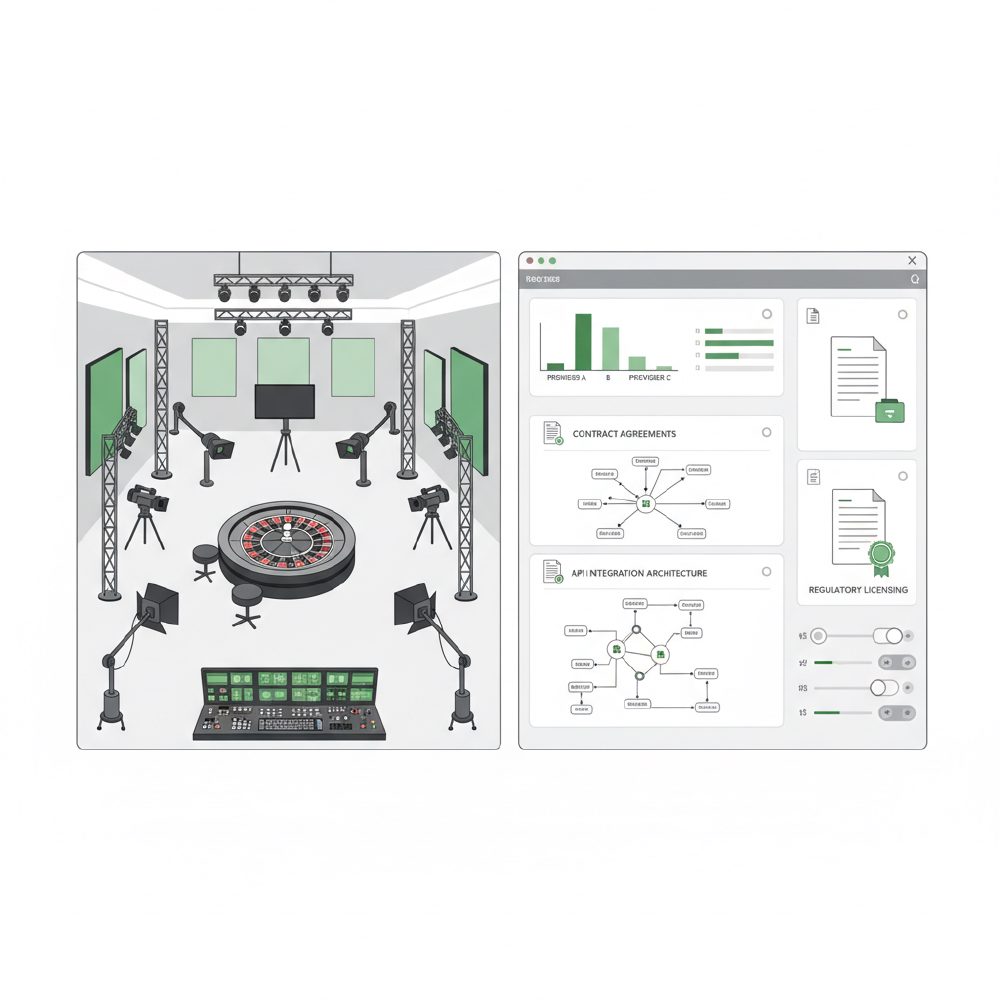
What should operators actually look for in a live casino provider?
The four variables that matter most are game depth (number of unique table variants), table availability (shared vs. dedicated), mobile rendering quality, and the revenue share or flat-fee structure. Studio brand recognition is a distant fifth — players care less about the logo than operators assume, but they absolutely notice latency and a thin lobby.
Most operators spend too much time comparing game counts and not enough time stress-testing the commercial model. A provider quoting 18% revenue share sounds reasonable until you factor in a $10,000/month minimum guarantee on dedicated tables, a $25,000 integration fee, and a six-month lock-in. I've seen operators burn through their runway before they hit the traffic levels that make those minimums viable.
Mobile performance is non-negotiable in 2026. Across LATAM and Southeast Asia — two of the fastest-growing live casino markets — more than 70% of sessions come from mobile. Providers that still rely on Flash-era streaming architectures, or that serve a single HD stream regardless of bandwidth, will crater your session length metrics. Ask every shortlisted vendor for their adaptive bitrate specs and their P95 latency figures before you sign anything.
Shared tables versus dedicated tables is the other fork in the road. Shared tables cost far less (often included in a base integration fee) but carry the provider's generic branding, and you have zero control over dealer appearance or table limits. Dedicated tables let you white-label the environment, set custom limits, and run branded promotions — but the economics only make sense above a certain player volume. Most providers set that threshold somewhere between 200 and 500 concurrent live players, though they rarely advertise it that plainly.
How does Evolution Gaming compare to other live casino providers?
Evolution is the undisputed market leader — it supplies live casino content to the majority of licensed operators globally and runs the most recognizable game shows (Crazy Time, Lightning Roulette, Monopoly Live). The trade-off is cost: Evolution's revenue share is typically the highest in the sector, and its integration requirements are among the most demanding for smaller operators.
Evolution's library as of 2026 runs past 700 live titles when you count all regional roulette and baccarat variants, game shows, and the RNG-adjacent First Person series. That breadth is genuinely hard to match. The acquisition of NetEnt (2020), Ezugi, and Big Time Gaming gave Evolution a content portfolio that no single competitor has replicated. For an operator targeting a broad international audience, Evolution as your primary live provider is the defensible default.
The commercial reality is more complicated. Revenue share for a new operator without leverage typically lands in the 15–20% range, though large-volume operators with established traffic have negotiated into single digits. There is also a technical integration layer: Evolution runs its own Game Launch Client, and while it supports standard API integration, getting certified on their system takes 4–8 weeks even with a competent tech team. White-label platforms like SoftSwiss or EveryMatrix handle this integration for you, but you're adding their margin on top.
The geographic restriction issue is real and often catches operators off guard. Evolution has withdrawn or restricted supply in several jurisdictions following regulatory actions, and in the US it only supplies operators holding a valid state license in markets where it is itself certified (New Jersey, Pennsylvania, Michigan, Connecticut as of early 2026). If your roadmap includes US expansion, verify Evolution's current state-by-state availability before you build your lobby architecture around them.
| Provider | Live Game Count (approx.) | Shared Tables | Dedicated Tables | Typical Rev Share Range | Key Regulated Markets |
|---|---|---|---|---|---|
| Evolution Gaming | 700+ | Yes | Yes (volume threshold) | 15–20% (new operators) | MGA, UKGC, NJ, PA, MI, DK, SE |
| Pragmatic Play Live | 200+ | Yes | Yes | 12–18% | MGA, UKGC, Curaçao, CO, NJ |
| Playtech Live | 300+ | Yes | Yes | 12–18% | MGA, UKGC, IT, ES, RO, NJ |
| Ezugi (Evolution subsidiary) | 150+ | Yes | Yes | 10–16% | MGA, Curaçao, CO, NJ |
| Authentic Gaming | 50+ | Yes | Limited | 12–17% | MGA, UKGC, Curaçao |
| BetGames | 20+ | Yes | No | 10–15% | MGA, Curaçao, LATAM |
Is Pragmatic Play Live a viable alternative for new operators?
Yes — Pragmatic Play Live is the most operator-friendly alternative to Evolution for a launch-stage business. Its revenue share is typically lower, its integration is faster through aggregator connections, and its Curaçao and MGA certifications cover most offshore and mid-tier regulated markets. The game library is smaller, but the core titles (Speed Roulette, Mega Roulette, One Blackjack) are strong performers.
Pragmatic Play built its live studio in Bucharest and expanded to a second facility in 2022. The production quality is genuinely competitive — 4K streaming, professional dealers, and a consistent UI that works cleanly on mobile. Where Pragmatic falls short of Evolution is in game show depth: it has Mega Wheel and a handful of lottery-style games, but nothing that competes with Crazy Time or Monopoly Live for player engagement time. If game shows are core to your acquisition strategy, you'll likely need Evolution alongside Pragmatic.
For operators entering LATAM markets — particularly Colombia (Coljuegos), Peru (MINCETUR), or Mexico (SEGOB/DGAJS) — Pragmatic Play is often the faster path to a compliant live lobby. Their localization work in Spanish and Portuguese is solid, and their account management teams have experience with regional operator requirements. Evolution is present in these markets too, but their onboarding process for smaller regional operators is slower.
One practical advantage: Pragmatic Play Live is available through virtually every major aggregator, including SoftSwiss, EveryMatrix, Relax Gaming's Silver Bullet, and Slotegrator. If you're launching on a white-label platform, there's a reasonable chance Pragmatic is already pre-integrated. That can shave 3–6 weeks off your go-live timeline — which matters when you're paying platform fees from day one.
What does Playtech Live offer that other providers don't?
Playtech's primary differentiator is its regulated-market depth, particularly in Southern and Eastern Europe — Italy, Spain, Romania, and the UK. Its Age of the Gods live slots and branded table environments (Prestige Roulette, etc.) offer genuine product differentiation. For operators targeting those specific regulated markets, Playtech's existing compliance footprint is a real operational advantage.
Playtech operates its own live studio in Riga and has licensed studio operations in multiple regulated jurisdictions, including a New Jersey-certified facility. That in-jurisdiction presence matters enormously in markets like Italy (ADM) and Spain (DGOJ), where regulators require live content to be streamed from approved facilities. Evolution has the same capability, but Playtech's existing operator relationships in those markets — particularly through its IMS platform — mean a faster path to launch for operators already in the Playtech ecosystem.
The downside is that Playtech is not the right choice for an offshore-first or crypto operator. Their KYC and compliance requirements are stringent, their onboarding is slow (expect 8–12 weeks for a full integration), and their commercial terms are structured around large-volume operators. If you're launching a Curaçao-licensed casino with ambitions to scale, Playtech is a future consideration, not a day-one partner.
Playtech's IMS (Information Management System) is worth understanding separately from the live content itself. It's a player management and CRM layer that many Playtech-powered operators use, and it creates a degree of platform lock-in. If you're evaluating Playtech Live as a content-only addition to a third-party platform, make sure your aggregator connection doesn't require the full IMS stack — some do, some don't, and the contract language is often ambiguous.
Should a new operator use an aggregator or go direct with a live casino games provider?
For operators under 1,000 daily active players, an aggregator is almost always the right call. Direct studio deals require minimum revenue guarantees, dedicated integration work, and ongoing technical maintenance that a lean team simply can't absorb at launch. The aggregator margin — typically 2–5% on top of studio revenue share — is worth paying for the operational simplicity.
The aggregator model means one API, one contract, one reconciliation process, and one support relationship. SoftSwiss Game Aggregator, EveryMatrix GameHub, and Slotegrator are the three I see most often in operator contracts at the sub-$5M annual GGR stage. SoftSwiss is particularly strong for crypto-friendly operators given its deep integration with crypto payment processors and its familiarity with Curaçao and Anjouan licensing structures. EveryMatrix has a cleaner enterprise-grade API and better tooling for operators who want granular lobby management.
The math changes once you're generating meaningful volume. At roughly $5–10M annual GGR from live casino, the aggregator's 2–5% take starts to represent real money — potentially $100,000–$500,000 annually that a direct deal would eliminate. That's the point at which it makes sense to open direct negotiations with your top two or three studios. Most studios will engage seriously once you can demonstrate 12 months of audited GGR data and a credible player base.
One thing aggregators don't always advertise: not every live studio is available through every aggregator. Evolution, notably, does not distribute through third-party aggregators in most markets — you must integrate directly or use a platform that has a pre-existing Evolution deal. This is a genuine constraint that changes the calculus for operators who want Evolution as their anchor live product.
| Factor | Via Aggregator | Direct Studio Deal |
|---|---|---|
| Integration timeline | 2–6 weeks (pre-built connectors) | 6–16 weeks (full certification) |
| Upfront integration cost | $5,000–$20,000 (aggregator fee) | $15,000–$50,000+ per studio |
| Revenue share economics | Studio rate + 2–5% aggregator layer | Studio rate only (negotiable at volume) |
| Content breadth | Multiple studios, one contract | Single studio per contract |
| Evolution Gaming access | Not available via aggregator | Direct only |
| Minimum guarantees | Usually none at aggregator level | Often $5,000–$25,000/month per studio |
| Compliance support | Aggregator handles studio certifications | Operator manages per-studio compliance |
How do licensing requirements affect which live dealer casino provider you can use?
Your operating license determines which studios will supply you — and in some cases, which studios are legally permitted to supply you. Curaçao and Anjouan licenses unlock the widest provider access. MGA and UKGC licenses require studios that are themselves certified in those jurisdictions. US state licenses require in-state or state-approved studio infrastructure, which only a handful of providers have built.
The Curaçao Gaming Authority (post-2023 reform under the new National Ordinance) now requires operators to use only B2B suppliers that hold their own Curaçao certification or an equivalent recognized license. This has quietly narrowed the supplier pool for Curaçao operators — some smaller live studios that operated in a gray zone are no longer compliant partners. Pragmatic Play, Ezugi, BetGames, and several others hold Curaçao B2B licenses; always verify current status directly with the provider.
For MGA-licensed operators (Malta), the regulator's Approved Games List is the controlling document. Every live game title must be individually approved and tested by an accredited testing lab (eCOGRA, BMM, GLI). This adds 4–8 weeks to the launch timeline per studio and creates an ongoing compliance overhead every time a studio releases a new variant. Evolution, Playtech, and Pragmatic Play all maintain current MGA approvals, but smaller studios may have gaps in their approved title lists.
US state licensing is the most restrictive environment. New Jersey's DGE, Pennsylvania's PGCB, and Michigan's MGCB each require live dealers to operate from facilities that have been physically inspected and approved. Evolution has certified facilities in Atlantic City (NJ) and has remote-deal arrangements for PA and MI. Playtech has NJ certification. If you're building a US-facing operator, your live casino provider shortlist is essentially Evolution and Playtech, with a few state-specific smaller studios as supplementary options.
What are the real costs of adding live casino content to a new operator platform?
Budget $30,000–$100,000 in first-year live casino costs before revenue share, depending on whether you go aggregator or direct, and whether you need dedicated tables. The recurring revenue share (typically 12–20%) then runs on every dollar of live GGR. Minimum monthly guarantees on dedicated tables can add $60,000–$300,000 annually regardless of your actual performance.
Breaking it down: a direct Evolution integration costs roughly $25,000–$50,000 in one-time technical fees, plus a $5,000–$15,000 annual certification maintenance fee. Pragmatic Play via aggregator might cost $5,000–$10,000 upfront with no ongoing integration fee beyond the aggregator's margin. Dedicated Evolution tables carry a minimum monthly guarantee — the exact figure is under NDA but operators I've spoken with cite ranges of $8,000–$25,000/month depending on table type and exclusivity level. That's before you've generated a single dollar of GGR.
The revenue share math deserves a worked example. Assume your live casino generates $500,000 GGR in month 12. At 18% revenue share, that's $90,000 to the studio. If you're on an aggregator adding 3%, it's $105,000. On a $500K GGR run rate, the difference between a direct deal at 15% and an aggregator deal at 21% is $30,000/month — $360,000 annually. That's the moment to renegotiate or go direct.
Hidden costs operators consistently underestimate: testing lab fees for game certification ($2,000–$5,000 per studio per jurisdiction), live casino-specific responsible gambling tooling (session timers, reality checks — required in UKGC and MGA markets), and the customer support overhead of handling live game disputes. Live dealer disputes are more complex than slot disputes and require video review processes that most first-time operators haven't staffed for.
Which live casino provider is best for crypto casinos and offshore operators?
Pragmatic Play Live and Ezugi are the most practical choices for crypto-first or offshore operators. Both hold Curaçao and Anjouan-compatible certifications, both are available through crypto-friendly aggregators like SoftSwiss, and neither imposes the geographic restrictions that Evolution applies in certain markets. BetGames is worth considering for operators targeting African and LATAM markets with lower bandwidth infrastructure.
Crypto casino operators face a specific challenge: many live studios are uncomfortable with anonymous or pseudonymous play, even where the operator's license technically permits it. Pragmatic Play and Ezugi have worked with enough crypto operators to have clear internal policies — they require the operator to hold a valid B2C license and to maintain KYC records, but they don't mandate fiat-only payment processing. That distinction matters if your platform processes Bitcoin, Ethereum, or stablecoins at the cashier.
SoftSwiss, as both a platform provider and an aggregator, has built a live casino product specifically around the crypto operator use case. Its Game Aggregator includes Pragmatic Play Live, Ezugi, BetGames, and several smaller studios, all pre-integrated with crypto payment rails and Curaçao/Anjouan compliance tooling. If you're launching a crypto casino on the SoftSwiss platform, you can have a functional live lobby in 4–6 weeks — that's genuinely fast by industry standards.
One provider worth flagging for the offshore segment: Vivo Gaming. It's a smaller studio but has built a niche in Latin American markets with Spanish-speaking dealers, local game variants (like Andar Bahar for South Asian audiences), and a commercial model that is more flexible for low-volume operators than the major studios. I wouldn't make it your anchor provider, but as a supplementary studio for regional differentiation, it's underrated.
How long does it take to integrate a live casino provider?
Via an aggregator with pre-built connectors: 2–6 weeks from contract signing to live lobby. Direct integration with a major studio like Evolution: 6–16 weeks, accounting for technical certification, compliance review, and game approval processes. US state-regulated markets add 4–12 weeks for regulatory review on top of the technical timeline.
The bottleneck is almost never the API work itself — modern REST APIs for live casino content are well-documented and a competent back-end developer can complete the integration in days. The time is consumed by vendor security reviews, test environment access provisioning, compliance certification (particularly the game RTP and RNG audit requirements), and the internal approval processes at the studio side. Evolution's certification process is the most thorough and the slowest; Ezugi and Pragmatic Play are meaningfully faster.
If you're on a white-label platform (say, SoftSwiss Turnkey or EveryMatrix Casino), the studio integrations are already done at the platform level. Your timeline shrinks to configuring your lobby, agreeing commercial terms with the studio (which the platform often facilitates), and passing any jurisdiction-specific compliance checks. I've seen operators go from signed platform contract to live lobby in under three weeks on this model — though that's the optimistic end of the range.
Plan for delays. Studios have onboarding queues, especially in Q3 and Q4 when everyone is trying to launch before the holiday season. If your target go-live is November or December, start your provider onboarding process no later than August. Missing the holiday window by even two weeks is a material revenue impact for a new operator.
What technical requirements do live casino providers impose on operators?
At minimum, you need a certified RNG (for any RNG-adjacent live products), a player authentication API, a wallet integration capable of real-time balance updates, and a CDN or streaming delivery layer capable of handling concurrent HD video sessions. Most studios also require a dedicated test environment and a documented responsible gambling implementation before they'll certify you for production.
The wallet integration requirement trips up more operators than anything else. Live casino requires real-time, sub-100ms wallet calls — if a player places a bet and the balance update lags, you get duplicate bets, negative balance disputes, and potential regulatory issues. This is not the place to use a batch-reconciliation payment architecture. Evolution's documentation is explicit about this; Pragmatic Play's is less so, but the requirement is the same in practice.
Video delivery infrastructure is the other technical area where operators underinvest. The studio handles the actual streaming origin, but you're responsible for ensuring your platform can handle the CDN load for concurrent sessions without buffering. This matters most in markets with variable bandwidth — LATAM, parts of Africa, Southeast Asia. Test your platform's video delivery under simulated load before launch, not after your first marketing campaign drives a traffic spike.
Responsible gambling tooling is now a technical requirement, not just a compliance checkbox, for any studio certified in MGA or UKGC markets. Session time limits, deposit limits, reality checks, and self-exclusion integration must be implemented at the operator level and demonstrably functional before the studio will certify you. Budget 2–4 weeks of development time for this if your platform doesn't include it out of the box.
- Evolution Gaming — Market leader with 700+ live titles, game shows, and the deepest regulated-market footprint. Highest revenue share and most demanding integration — the default choice for operators targeting broad international audiences.
- Pragmatic Play Live — Best operator-friendly alternative to Evolution. Lower revenue share, faster integration via aggregators, strong LATAM localization, and solid Curaçao/MGA certifications. Ideal anchor provider for launch-stage operators.
- Playtech Live — Best choice for operators targeting Southern and Eastern European regulated markets (Italy, Spain, Romania, UK). Slower onboarding and higher volume expectations, but unmatched compliance infrastructure in those jurisdictions.
- Ezugi (Evolution subsidiary) — More accessible commercial terms than parent company Evolution, available through aggregators, and strong in emerging markets. Good secondary provider for operators who want Evolution-group quality without the full Evolution commercial model.
- Authentic Gaming — Specializes in land-based casino streaming — real tables from physical casinos streamed to online players. Unique product differentiation for operators targeting players who want an authentic brick-and-mortar feel.
- BetGames — Lottery-style and bet-on-games live content rather than traditional table games. Strong in African and LATAM markets with lower bandwidth requirements. Complements a standard live lobby rather than replacing it.
- Vivo Gaming — Smaller studio with flexible commercial terms and strong Spanish/Portuguese localization. Underrated option for LATAM-focused operators or as a supplementary studio for regional game variants.





Comments
No comments yet, be the first.