Custom Casino Software Development in 2026: When Building From Scratch Actually Makes Sense
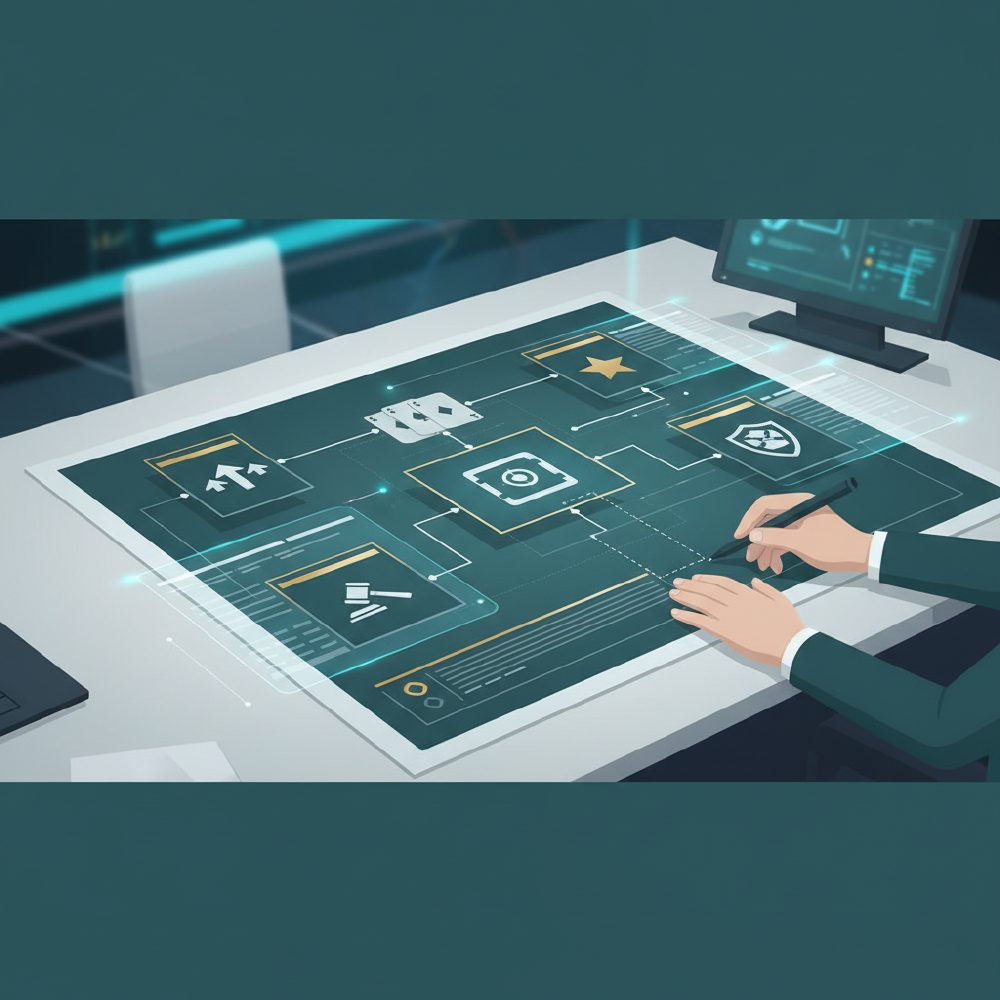
What exactly is custom casino software development?
Custom casino software development means building a casino platform — the back-office, player management system, bonus engine, payment layer, and front-end — from the ground up on proprietary code rather than licensing an existing platform. You own the software, control the roadmap, and carry the full engineering cost and risk.
The phrase gets used loosely, so let me be precise. A true custom build means your engineering team (in-house, outsourced, or hybrid) writes the core platform components: user authentication and KYC flows, wallet and transaction engine, game aggregation layer, CRM and bonus engine, reporting and BI stack, and the player-facing front-end. You may still license third-party game content through aggregators like Relax Gaming, GameArt, or directly from studios — that's normal. What you're building is the platform that sits around the content, not the slot reels themselves.
This is distinct from a white-label, where you rent a platform and operate under the licensor's master license, and from a turnkey solution, where a company like SoftSwiss or EveryMatrix delivers a pre-built platform under your own brand and license. Both of those routes involve licensing software you don't own. Custom development means you own the IP outright, which changes the economics, the timeline, and the risk profile completely.
There's also a middle path worth naming: some operators start with a turnkey platform and over several years replace components with proprietary modules — a custom bonus engine here, a bespoke payment router there. That evolutionary approach is often smarter than a big-bang custom build, and I'll come back to it. But when operators say 'we want to build custom,' they usually mean starting with a blank codebase, and that's the scenario this article addresses.
What does custom casino software development actually cost?
Expect $500K–$3M+ to reach a functional MVP, depending on scope, team location, and whether you're building for a single jurisdiction or a multi-market platform. That's before ongoing engineering costs, which typically run $50K–$150K per month for a team capable of maintaining and evolving a live platform.
The wide range exists because 'custom casino platform' covers very different scopes. A lean MVP targeting a single market — say, a Curaçao-licensed crypto casino with a focused game lobby and basic bonus tools — might be achievable for $500K–$800K with an experienced nearshore team in Eastern Europe or Latin America. A full-featured platform built to MGA standards, with multi-currency wallets, a sophisticated sportsbook integration, and a real-time risk management layer, will push well past $2M before you go live. I've seen operators underestimate this by a factor of three because their initial spec didn't account for compliance tooling, responsible gambling modules, or the sheer complexity of a reliable payment abstraction layer.
Beyond the build cost, you need to budget for infrastructure (AWS or GCP hosting for a casino platform with serious traffic isn't cheap — $10K–$30K per month is realistic at scale), third-party licensing (game aggregator fees, KYC/AML provider contracts, fraud tooling), and a QA and security audit before you can go live with any serious regulator. A penetration test and code audit from a firm like iBet or BMM Testlabs adds another $30K–$100K depending on scope.
The cost operators most consistently underestimate is post-launch engineering. A casino platform is a living system — payment providers change APIs, regulators issue new technical standards, game studios update their SDKs. You need a permanent engineering team to keep the lights on. Budget at least four to six senior engineers plus a DevOps function as your baseline. At Eastern European rates that's $50K–$80K per month; at Western European or US rates, double it. This is the recurring cost that makes the build-vs-buy math so unfavorable for most operators.
| Dimension | Custom Build | Turnkey (e.g. SoftSwiss, EveryMatrix) | White-Label |
|---|---|---|---|
| Upfront cost | $500K–$3M+ | $50K–$200K setup | $5K–$30K setup |
| Monthly platform cost | Engineering team ($50K–$150K+) | Rev share 15–25% + flat fee | Rev share 30–50% |
| Time to first player | 12–24 months | 3–6 months | 4–12 weeks |
| IP ownership | Full ownership | License only | License only |
| Customization ceiling | Unlimited | Moderate (config-level) | Low |
| Regulatory flexibility | High (you control the tech) | Medium (provider's roadmap) | Low (master license constraints) |
| Ongoing maintenance burden | Entirely yours | Shared with provider | Mostly on provider |
How long does a custom casino platform take to build?
A realistic timeline from kickoff to a live, regulated platform is 12–24 months. Operators who plan for 6–9 months almost always slip. The bottlenecks are rarely the core game lobby — they're the payment integrations, compliance tooling, and the back-and-forth with regulators during technical certification.
Here's how the timeline typically breaks down: the first three to four months go into architecture decisions, team assembly, and building the foundational components — authentication, wallet, basic back-office. Months four through eight cover game aggregation integration (connecting to a single aggregator like Softgamings or Slotegrator is faster than building direct studio connections), the bonus engine, and the player-facing front-end. Months eight through twelve are almost entirely consumed by payment integrations, KYC/AML provider connections, internal QA, and preparing the technical documentation regulators require.
The certification phase is where projects die or get delayed by six months. MGA technical certification, for example, requires documented RNG testing, responsible gambling tool functionality, and a detailed system description. Curaçao's newer licensing framework under the National Ordinance on Offshore Games of Hazard (introduced in 2023 and still being refined as of 2025) has tightened its technical requirements significantly. If your platform isn't built with those requirements in mind from day one, you'll be doing expensive rework during certification.
A 24-month timeline sounds painful, but it's honest. I've watched operators launch on a custom platform after 14 months and spend the next six months in firefighting mode because the payment layer wasn't stable under real load. The operators who build well take their time on infrastructure and load testing before they ever turn on marketing spend. The ones who rush almost always pay for it in player complaints, chargebacks, and emergency engineering sprints.
Which operators should actually consider a custom casino software build?
Custom development makes sense for three operator profiles: established operators with $5M+ in annual GGR who've outgrown their platform's limitations, well-capitalized new entrants with a genuinely differentiated product concept that existing platforms can't support, and operators in jurisdictions where local technical requirements make standard platforms non-compliant.
The first profile is the most common legitimate case. An operator running on SoftSwiss or EveryMatrix for three years, doing solid numbers, and hitting the ceiling of what the platform's configuration allows — custom bonus mechanics, a proprietary loyalty system, deep data ownership — has a real business case for building out. They have revenue to fund the build, they understand what they actually need, and they're not guessing at product-market fit. This is the operator who should be talking to a casino software development company about a phased custom build.
The second profile is rarer but real. If you have a product concept that's genuinely novel — say, a skill-based gaming layer on top of casino content, or a social casino with a specific monetization mechanic that no existing platform supports — you may have no choice but to build. But be honest with yourself: most 'unique' product concepts can be approximated on a turnkey platform. The question is whether the gap between 'approximated' and 'exactly right' is worth $1M+ and 18 months of your life.
The third profile is underappreciated. Some jurisdictions impose technical requirements that standard offshore platforms weren't built for. US state markets are the clearest example. New Jersey's Division of Gaming Enforcement has specific technical standards for its iGaming market that most white-label platforms aren't certified for. Pennsylvania's PGCB has its own. If you're pursuing a US state license and you want to own your technology, a custom build (or a heavily customized enterprise platform) may be the only path. Similarly, some LATAM markets — Colombia's Coljuegos or Peru's MINCETUR — have integration requirements with national systems that standard platforms handle poorly.
What are the core components a bespoke casino software build must include?
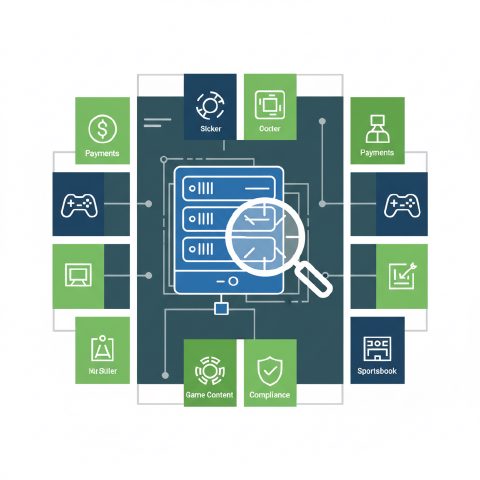
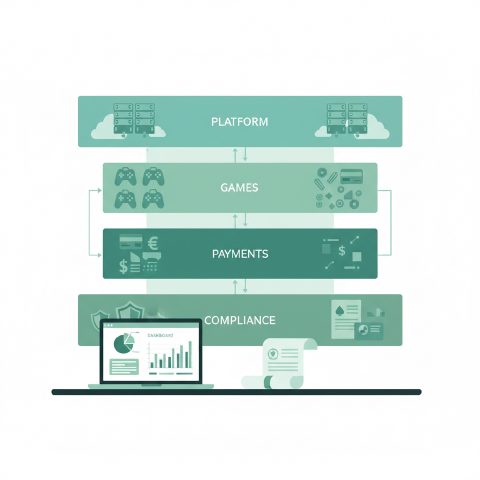
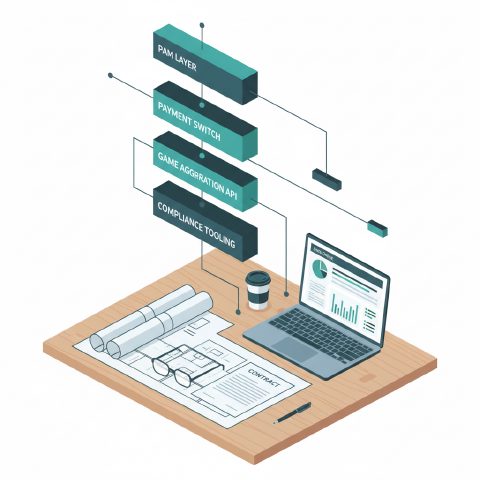
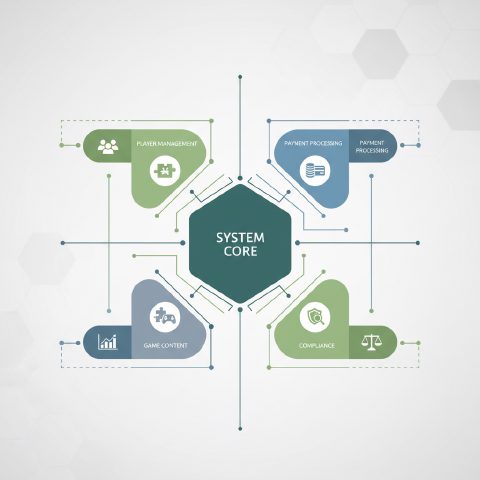
A complete bespoke casino software build requires seven core components: a player management system, wallet and transaction engine, game aggregation layer, bonus and promotion engine, CRM and communication tools, reporting and BI stack, and compliance and responsible gambling modules. Missing or underbuilding any one of these creates operational problems that are expensive to fix post-launch.
The player management system is your foundation — it handles registration, KYC verification (typically via a third-party provider like Sumsub or Onfido, not built from scratch), session management, and account status. The wallet engine needs to handle concurrent transactions without race conditions; this is a harder engineering problem than it sounds, and it's where amateur builds fail first. You'll want to support multiple currencies from day one, including crypto if you're targeting offshore markets, which means integrating a crypto payment processor like CoinsPaid or B2BinPay.
The game aggregation layer is where most operators take a pragmatic shortcut, and rightly so. Building direct integrations with 50+ studios is a multi-year project. Most custom platforms connect to one or two aggregators — Relax Gaming, Slotegrator, Softgamings, or similar — to access a broad game catalog quickly, then add direct studio deals for their highest-volume content over time. This is sensible. Don't let the perfect be the enemy of the good here.
The bonus engine deserves more engineering investment than most operators give it. A flexible, rule-based bonus engine that can handle wagering requirements, game restrictions, time limits, and multi-step promotions without manual intervention is a genuine competitive advantage. Standard platforms offer this at a configuration level; a custom build lets you implement mechanics that are genuinely differentiated. The CRM layer — player segmentation, triggered communications, lifecycle campaigns — is similarly high-value if done well, and it integrates tightly with the bonus engine.
Compliance modules are non-negotiable and often underscoped. You need deposit limits, session limits, self-exclusion with a proper cooling-off mechanism, reality checks, and integration with national self-exclusion registers where required (GAMSTOP in the UK, OASIS in Germany, Registro de Autoexclusión in Spain). If you're targeting a regulated market, build these to spec from day one. Retrofitting compliance tooling into a live platform is miserable work.
| Component | Typically Built Custom? | Common Third-Party Option | Notes |
|---|---|---|---|
| Player management / PMS | Yes | — | Core IP — always build |
| Wallet / transaction engine | Yes | — | Critical for data ownership and payment flexibility |
| KYC / identity verification | No — integrate | Sumsub, Onfido, Jumio | License and integrate; don't rebuild |
| Game aggregation layer | Partially | Relax, Slotegrator, Softgamings | Build the connector; license the aggregator |
| Bonus / promotion engine | Yes | — | High-value differentiator; worth building well |
| CRM / communications | Sometimes | Optimove, Salesforce Marketing Cloud | Depends on scale; many operators license |
| Payments abstraction layer | Yes | — | Own the routing logic; integrate PSPs via APIs |
| Fraud / risk management | No — integrate | Featurespace, Seon, Kount | License specialist tooling |
| Responsible gambling modules | Yes | GamCare-certified tools available | Must meet regulator spec; build or license certified solution |
| BI / reporting | Partially | Tableau, Looker, custom dashboards | Build the data warehouse; license visualization tools |
How do you choose a casino software development company for a bespoke build?
The right casino software development company has shipped at least two live casino platforms you can verify, employs engineers with iGaming-specific experience (not just general web dev), and can show you their approach to regulatory compliance and load testing. References from actual operators — not just testimonials on a website — are mandatory.
The iGaming development vendor market is full of companies that have built e-commerce platforms or fintech apps and are now pitching casino development. General software competence isn't enough. A casino platform has specific requirements — real-money transaction integrity, concurrent session handling, RNG certification, responsible gambling tooling — that require domain experience. Ask any vendor you're evaluating: have you shipped a platform that passed MGA or Curaçao technical certification? Can I speak to the operator? If the answer is vague, walk away.
Evaluate vendors on their architecture choices as well as their portfolio. A vendor proposing a monolithic architecture in 2026 should raise flags — modern casino platforms are built on microservices or at minimum a service-oriented architecture that allows components to be updated or replaced independently. Ask about their approach to database consistency under concurrent transactions, their CI/CD pipeline, and how they handle payment provider API changes. These questions reveal whether you're talking to engineers who understand the domain or generalists who've read the brief.
Geography matters for cost but also for timezone and communication. Eastern European teams (Poland, Ukraine, Romania, Serbia) offer strong engineering talent at $40–$80/hour for senior developers and have a long track record in iGaming. Latin American teams (Argentina, Colombia) are increasingly competitive and offer better timezone overlap for US-based operators. Offshore teams in South or Southeast Asia can be cheaper but require more management overhead and often lack iGaming-specific experience. Whatever you choose, build in a senior technical lead on your side who can review architecture decisions — don't outsource judgment entirely.
What licensing and regulatory requirements affect a custom casino platform?
The licensing jurisdiction you target shapes your technical requirements more than any other single factor. MGA and UKGC impose the strictest technical standards; Curaçao and Anjouan are more flexible but increasingly require documented system descriptions. US state licenses (NJ, PA, MI) have the most prescriptive technical certification processes of any market.
If you're building for an MGA (Malta Gaming Authority) license, your platform must meet the MGA's technical standards document, which covers everything from RNG certification to data retention periods to responsible gambling tool functionality. You'll need a third-party technical audit before going live, and the MGA can and does conduct its own system reviews. The MGA license is expensive (€25,000 application fee, annual compliance costs in the six figures) but opens the door to EU players and gives you credibility with payment processors and game studios that won't deal with offshore operators.
Curaçao's licensing regime went through a significant overhaul starting in 2023 under the new National Ordinance on Offshore Games of Hazard. The new framework requires operators to hold their own license (rather than operating as a sub-license under a master license holder) and imposes more formal technical and AML requirements than the old system. As of 2025 the transition is still ongoing, and the exact technical certification requirements are more demanding than they were under the old regime — if you're building a custom platform for Curaçao, verify current requirements directly with the Curaçao Gaming Control Board rather than relying on advice from 2022 or earlier.
For US state markets, the technical bar is the highest in the world. New Jersey's DGE requires a full system submission, lab testing by an approved testing laboratory (GLI, BMM, or Gaming Laboratories International), and a detailed technical standards compliance report. Pennsylvania's PGCB and Michigan's MGCB have similar processes. If you're building a custom platform for a US state market, budget an additional $150K–$300K for lab testing and technical certification, and plan for a 6–12 month certification timeline on top of your build timeline.
What are the biggest risks operators face with a custom casino software development project?
The three risks that kill custom casino builds are scope creep that doubles the timeline, underestimating the ongoing engineering cost after launch, and building a platform that can't pass technical certification because compliance requirements weren't built in from the start. All three are avoidable with proper planning — but they require discipline most first-time operators don't have.
Scope creep is endemic to custom builds. The initial spec looks clean, then stakeholders start adding features — a sportsbook integration, a live casino vertical, a loyalty points system — and suddenly a 12-month project is 20 months and twice the budget. The discipline required is writing a locked MVP scope before you sign a development contract and treating any additions as separate projects with separate budgets and timelines. This sounds obvious; almost nobody does it consistently.
The ongoing engineering cost trap is the one I see hurt operators most. They budget carefully for the build, launch successfully, and then discover that maintaining a live casino platform consumes more engineering resource than building it. Payment providers change their APIs. A game studio releases a new SDK version that breaks your integration. A regulator issues a new technical standard with a 90-day compliance deadline. Each of these requires engineering time, and they happen constantly. Operators who don't budget for a permanent, dedicated engineering team post-launch end up with a platform that slowly degrades in stability and compliance posture.
The certification failure risk is particularly costly because it comes late in the project when you've already spent most of your budget. I've seen operators complete a 14-month build only to discover during technical certification that their responsible gambling tools don't meet the regulator's spec, or that their RNG implementation wasn't documented in the way the testing lab requires. These aren't insurmountable problems, but fixing them adds months and costs that weren't in the plan. The mitigation is straightforward: hire a compliance consultant with experience in your target jurisdiction before you write a line of code, and have them review your technical spec before development starts.
How does a custom build compare to using an enterprise platform like EveryMatrix or SoftSwiss?
Enterprise turnkey platforms like EveryMatrix CasinoEngine or SoftSwiss Casino Platform offer 80–90% of the functionality a custom build provides, at a fraction of the cost and timeline. The gap is in the 10–20% of functionality that's genuinely proprietary — and whether that gap matters depends entirely on your product strategy.
SoftSwiss Casino Platform and EveryMatrix CasinoEngine are genuinely sophisticated pieces of software. SoftSwiss powers hundreds of operators and has invested heavily in its back-office tooling, game aggregation (through its own aggregator), and crypto payment handling. EveryMatrix's modular architecture lets operators mix and match components — you can use their game aggregator (GameMatrix) without using their full platform, for example. Pronet Gaming, Digitain, and Altenar are other enterprise options worth evaluating depending on your vertical mix. These aren't simple white-labels; they're configurable platforms with real depth.
Where enterprise platforms fall short is in the areas that require genuine code-level customization: novel bonus mechanics that go beyond the platform's configuration options, deep integration with proprietary data systems, or a UX vision that the platform's front-end simply can't support. If your competitive advantage is operational excellence — better customer service, smarter marketing, a well-curated game lobby — an enterprise platform is almost certainly the right choice. If your competitive advantage is the product itself — a genuinely different player experience that can't be replicated on a standard platform — then a custom build deserves serious consideration.
A hybrid approach is worth naming explicitly: start on an enterprise platform to validate your market and revenue model, then invest custom engineering into the specific components where differentiation matters. Several successful operators I've worked with followed this path — three years on SoftSwiss, then a custom bonus engine and CRM layer built on top, then eventually a full platform migration once they had the revenue and the product clarity to justify it. This is lower risk than a big-bang custom build and often produces a better outcome because you build on real operational experience rather than assumptions.
What payment infrastructure decisions are unique to a custom casino build?
When you build custom, you own the payment routing layer entirely — which is both the biggest advantage and the biggest operational headache. You can implement intelligent payment routing, multi-PSP failover, and crypto-fiat conversion logic that no standard platform offers. You also inherit full responsibility for PCI DSS compliance, chargeback management, and PSP relationship maintenance.
On a white-label or turnkey platform, the platform provider handles most of the payment complexity — they maintain PSP integrations, manage PCI DSS compliance at the platform level, and absorb some of the chargeback risk. On a custom build, that's all yours. PCI DSS compliance for a platform that handles card data is a significant undertaking — a Level 1 PCI DSS assessment (required if you process more than 6 million Visa/Mastercard transactions per year) costs $50K–$200K and requires ongoing quarterly scans and annual audits. Most operators mitigate this by using a payment service provider that tokenizes card data, keeping raw card numbers off your servers entirely, but you still need to document and certify your environment.
The upside of owning your payment layer is real. You can build intelligent routing logic that sends transactions to the PSP most likely to approve them based on card BIN, country, and historical approval rates. You can implement instant crypto-to-fiat conversion at the wallet level. You can build custom fraud scoring that integrates with your player risk model. These capabilities translate directly into higher deposit conversion rates, which at scale are worth significant revenue. Operators on standard platforms are stuck with whatever routing logic the platform provider has implemented.
For crypto-focused operators — a growing segment in offshore markets — building a custom payment layer is particularly valuable. Integrating CoinsPaid, B2BinPay, or NOWPayments at the platform level and building a multi-currency wallet that handles Bitcoin, Ethereum, USDT, and other assets natively gives you flexibility that most standard platforms don't offer cleanly. The engineering complexity is real, but the player experience improvement and the ability to serve markets where traditional payment methods are restricted make it worthwhile for the right operator profile.
Is custom casino software development worth it — what's the honest ROI case?
The ROI case for custom development is real but narrow. It works for operators with proven revenue, a specific product differentiation thesis, and the organizational capacity to run an engineering function permanently. For most operators — especially first-time entrants — the ROI doesn't close, and the opportunity cost of 18 months not generating revenue is the killer.
Let's run the numbers honestly. Assume a custom build costs $1.5M and takes 18 months. During those 18 months, a competitor using a turnkey platform has been live for 12 months, has acquired players, and has real data to optimize against. Your $1.5M build cost, amortized over five years, is $300K per year — but you're also running a $80K/month engineering team, so your total platform cost is roughly $1.26M per year. A turnkey platform at 20% revenue share on $5M GGR costs you $1M per year. The math looks close, and it is — but the turnkey operator has a 12-month head start and real market learning that you don't.
The ROI case improves dramatically at higher GGR. At $15M annual GGR, a 20% revenue share costs $3M per year. Your custom platform engineering costs are still $1.26M per year. The $1.74M annual saving pays back your $1.5M build cost in under a year. This is why the custom build decision is almost always the right one for operators above a certain revenue threshold and almost always wrong for operators below it. The threshold is somewhere around $8–12M annual GGR, though it varies with your specific platform deal terms.
Beyond pure cost, there's a strategic value to owning your technology that doesn't show up cleanly in ROI calculations: you're not dependent on a platform vendor's roadmap, you can't be dropped as a client, and your platform is an asset you can sell or license. Several operators I know have built custom platforms and then licensed them to other operators, creating a B2B revenue stream that significantly changes the economics. That's not a plan to build around, but it's a real option that platform licensees don't have.


Comments
No comments yet, be the first.