Telegram Casino Software Development: The Operator's Complete Build Guide for 2026
What exactly is a Telegram casino and how does the software architecture work?
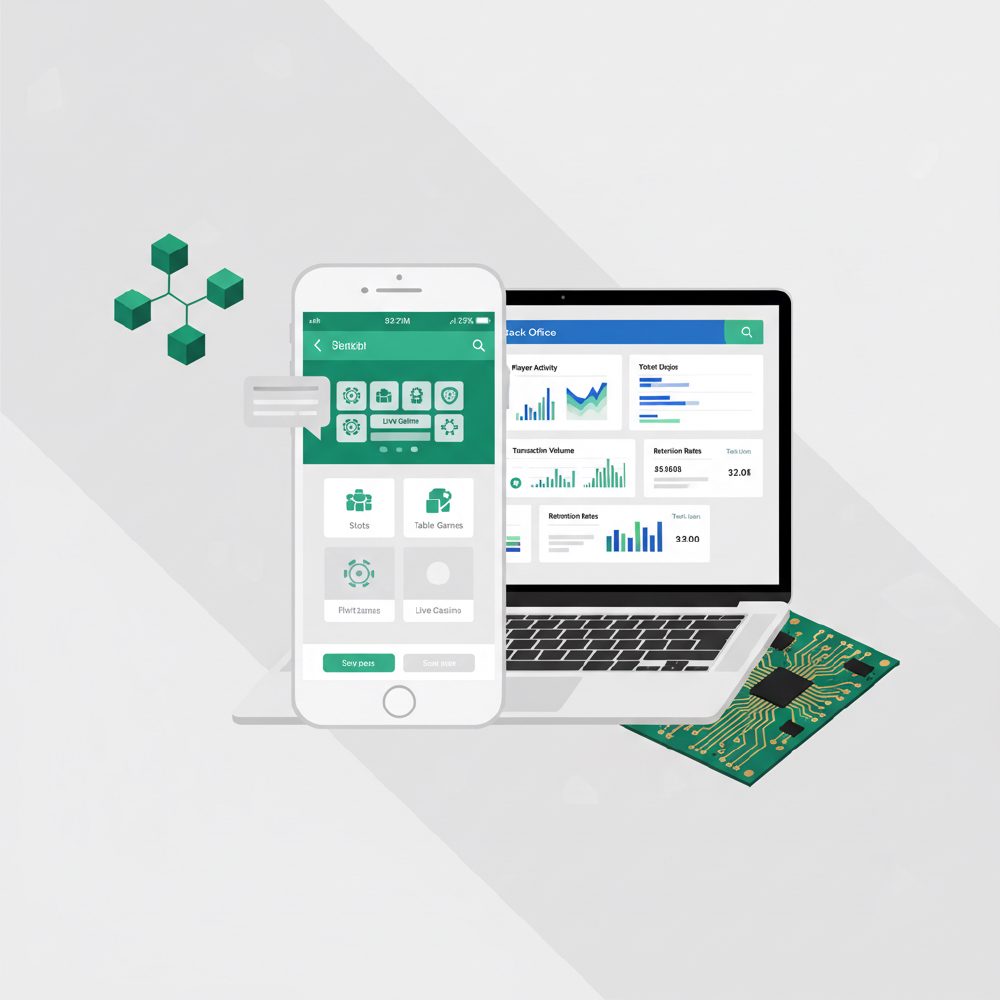
A Telegram casino is an iGaming product delivered through Telegram's Mini App (TMA) framework — a WebView container that runs a full HTML5 web application inside the Telegram client. Users never leave the app. The casino logic, wallet, game launcher and player account all live inside that WebView, authenticated via Telegram's initData signature rather than a traditional username/password flow.
Most operators who ask me about Telegram casino software development have a vague mental model of a Telegram bot that sends slot results via chat messages. That was 2021. What operators are actually building in 2026 is a full-stack web casino — RNG games, live dealer lobbies, sportsbook widgets — delivered through Telegram's Mini App API. The TMA framework gives you access to the Telegram user's verified identity (user ID, username, language), their device info, and a native payment sheet via Telegram Stars or TON Connect. That is a meaningful distribution advantage: your casino loads inside an app that 900 million monthly actives already have installed.
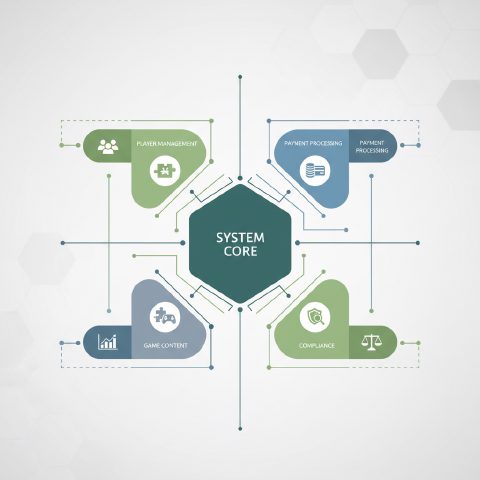
The server-side architecture looks almost identical to a conventional online casino. You need a game aggregation layer (RGS), a player account management system (PAM), a wallet service, a bonus engine, and a reporting back-office. The difference is the frontend: instead of a standalone domain, your React or Vue app is served from a web host but launched via a Telegram bot command or deep link. Telegram's WebApp.initData JWT is validated on your backend to confirm the user's identity without a separate registration form — which is the UX hook that makes Telegram casinos convert so well in crypto-native audiences.
One architectural decision that catches operators off-guard: Telegram Mini Apps run in a sandboxed WebView that restricts certain browser APIs. Autoplay audio, some WebGL features, and clipboard access behave differently across iOS and Android Telegram clients. Your QA process must specifically test on Telegram's iOS client, Android client, and Telegram Desktop — they are not identical environments. Any game aggregator you evaluate needs to confirm their HTML5 titles are TMA-compatible, not just mobile-responsive.
What are the main development paths — custom build, white-label or turnkey Telegram casino software?
You have three realistic paths: a fully custom build from a specialist development studio, a white-label Telegram casino platform from a B2B provider, or adapting an existing turnkey web casino platform to add a Telegram Mini App front-end. Each has a different cost floor, time-to-market and long-term flexibility trade-off. Most operators launching in 2026 are choosing the third option because they already have a platform contract.
Custom development gives you full control over UX, game integration, payment logic and player data architecture. You own the codebase. Studios with Telegram-specific iGaming experience — and there are not many yet — are quoting $150,000 to $400,000 for an MVP with a PAM, wallet, game lobby and basic bonus engine. Timeline is 9 to 18 months if you include QA and soft-launch cycles. The risk is that Telegram's Mini App API is still evolving; features that were in beta in 2024 are now stable, but the platform does make breaking changes. A custom build means your team absorbs that maintenance burden.
White-label Telegram casino solutions are emerging from providers like Slotegrator, which has published TMA-ready templates, and from several Eastern European studios that built Telegram products for the crypto gambling wave of 2022–2023. These typically bundle a PAM, a game lobby with 50–200 pre-integrated titles, a crypto wallet module, and a Telegram bot management layer. Costs range from $30,000 to $80,000 upfront plus a revenue share of 15–25% GGR or a flat monthly SaaS fee. You get to market in 3–5 months but you are constrained by the provider's roadmap and you share your player data with their infrastructure.
The third path — extending an existing turnkey platform — is underrated. If you are already running on EveryMatrix, SoftSwiss (now Devcode) or a similar platform, your PAM, game aggregation and payment stack already exist. You commission a Telegram Mini App frontend that connects to your existing APIs. This can be done for $20,000–$60,000 in frontend development and takes 2–4 months. You keep your existing license, your existing payment relationships, and your existing player database. The only new component is the TMA shell and Telegram bot management. For operators who already have a running casino, this is almost always the right answer.
| Path | Upfront Cost | Time to Market | Revenue Share / Ongoing | Code Ownership | Best For |
|---|---|---|---|---|---|
| Custom Build | $150K–$400K+ | 9–18 months | None (own infra) | Full | Well-funded operators wanting full IP control |
| White-Label TMA Platform | $30K–$80K | 3–5 months | 15–25% GGR or SaaS fee | None | First-time operators, lean budgets |
| Extend Existing Turnkey | $20K–$60K | 2–4 months | Existing platform terms | Partial (frontend) | Operators already live on EveryMatrix, SoftSwiss etc. |
Which license covers a Telegram casino and how do regulators treat this distribution channel?
No regulator has issued Telegram-specific gambling guidance as of mid-2026. The operative question is whether your existing or intended gambling license covers 'online gambling services delivered via third-party messaging platforms' — and most licenses do, provided you control the RNG, maintain player records, and enforce geo-blocking. Curaçao eGaming and Anjouan (ACCS) are the two most-used offshore licenses for Telegram casino operators right now.
I always tell operators to get a written legal opinion that specifically names Telegram as a distribution channel before they go live. A Curaçao Master License (post-2023 reform, now issued by GCB under the new National Ordinance) covers remote gambling services without channel-specific restrictions — but your compliance manual needs to document how you enforce geo-blocking inside a Telegram Mini App, how you verify player identity given the reduced friction of TMA onboarding, and how you handle AML monitoring on crypto deposits. Curaçao's GCB has been tightening enforcement since 2023 and operators who treated the license as a rubber stamp are getting deregistered.
Anjouan (ACCS) is cheaper — application fees around $10,000–$15,000 versus Curaçao's $30,000–$50,000 range for the new license — and the regulator is less prescriptive about technical standards. That is a double-edged sword. You get faster approval (sometimes 6–8 weeks) but less regulatory credibility if you ever want to move upmarket to MGA or UKGC-adjacent markets. For a crypto-focused Telegram casino targeting Tier 3 markets, Anjouan is pragmatic. For anything touching EU players, it is not sufficient.
US operators: Telegram casinos are not a regulatory workaround. If your geo-targeting includes any US state, you are subject to that state's online gambling laws regardless of the distribution channel. New Jersey, Pennsylvania, Michigan and Connecticut have licensed online casino frameworks — none of which permit unlicensed operators to serve their residents via Telegram or any other channel. The Wire Act analysis for US-facing Telegram casinos is the same as for any other online gambling product. Do not let the novelty of the channel confuse the legal analysis.
Social casino software development via Telegram sits in a different regulatory bucket entirely. If you are building a social casino — no real-money wagering, virtual currency only — you are outside gambling law in most jurisdictions but inside sweepstakes law in the US, consumer protection law in the EU, and app store policy constraints. Telegram does not restrict social casino Mini Apps the way Apple's App Store does, which is one reason social casino developers are moving aggressively into the TMA ecosystem.
How do bitcoin and TON payments work in Telegram casino software development?
Bitcoin Telegram casino software development centers on two payment layers: on-chain Bitcoin/Lightning for deposits and withdrawals, and TON (The Open Network) blockchain for in-app microtransactions via Telegram's native TON Connect wallet integration. TON is Telegram's own blockchain and gets privileged API access — it is the fastest path to a frictionless deposit experience inside the TMA environment.
TON Connect is the standout payment integration for any Telegram casino build in 2026. Telegram users who hold TON in their Telegram Wallet (which is built into the app for most regions) can approve a deposit in two taps without leaving the Mini App. There is no redirect, no external wallet app, no clipboard paste of a wallet address. The UX is closer to Apple Pay than to a traditional crypto deposit flow. For operators targeting crypto-native users who discovered gambling through Telegram channels, this is a genuine conversion advantage. TON transaction fees are sub-cent and settlement is near-instant.
Bitcoin integration typically runs through a payment processor layer — CoinsPaid, NOWPayments, or Coinspaid's white-label gateway are common choices. You generate a unique deposit address per player per session, monitor the mempool for confirmations, and credit the player's internal balance. For a Telegram casino targeting markets where Lightning Network adoption is high (parts of LATAM, Southeast Asia), Lightning deposits with zero-confirmation crediting are worth the added complexity. The development overhead for Lightning is real — you need to run or rent a Lightning node, manage channel liquidity, and handle edge cases around payment routing failures.
Fiat on-ramps are possible but they introduce friction that partially defeats the purpose of a Telegram-native experience. Embedding a card payment iframe inside a TMA WebView runs into Telegram's content security policy and Apple/Google payment restrictions on in-app purchases. Most operators who want fiat support route it through a crypto-fiat bridge (MoonPay, Transak) where the player buys crypto with a card and the casino receives crypto. This adds a step but keeps the casino out of card-acquiring compliance territory. If fiat is a primary requirement, a standalone web casino with a Telegram deep-link entry point is a cleaner architecture than a pure TMA build.
| Method | Integration Complexity | Deposit UX | Settlement Speed | Typical Fees | Best For |
|---|---|---|---|---|---|
| TON Connect (native) | Low — Telegram API | 2-tap, in-app | ~5 seconds | <0.01 USD per tx | Crypto-native Telegram users |
| Bitcoin (on-chain) | Medium — address generation + monitoring | External wallet required | 10–60 min (1–3 confirms) | Variable (network fee) | High-value deposits |
| Lightning Network | High — node management | Fast, QR-based | Near-instant | Sub-cent | Micro-bet, high-frequency players |
| Fiat via Crypto Bridge (MoonPay etc.) | Medium — iframe/redirect | Card → crypto step | 5–15 min | 1.5–4% conversion fee | Operators needing fiat access |
| Telegram Stars | Low — native API | In-app, instant | Instant | Telegram takes 30% | Social casino / virtual goods only |
What game content options exist and which aggregators support Telegram Mini App delivery?
Game content for Telegram casinos comes from three sources: direct studio integrations, game aggregators with TMA-compatible HTML5 libraries, and provably fair in-house crash/dice games built specifically for the Telegram format. Aggregator support for TMA is still patchy — you need to explicitly confirm WebView compatibility, not just mobile-responsive HTML5, before signing any content deal.
The aggregator route is the fastest path to a broad game lobby. Aggregators like Relax Gaming, Slotegrator, and Pariplay connect you to hundreds of studios under a single API. The catch for Telegram specifically is that their standard integration assumes a full browser environment. Several HTML5 slot titles use browser APIs — local storage, service workers, specific audio contexts — that behave differently inside Telegram's WebView. Before signing an aggregator contract, run their demo titles inside a Telegram Mini App test environment. I have seen operators sign aggregator deals, start development, and discover that 30% of the library does not render correctly in the TMA WebView. That is a painful conversation to have after the contract is signed.
BGaming and Spribe are two studios worth naming specifically. BGaming has been proactive about TMA compatibility and their crash game Aviator (via Spribe) is arguably the single most-played Telegram casino game type in 2024–2025. Spribe's Aviator runs well in WebView environments and the social/viral mechanics — sharing results in Telegram channels — are native to the platform. If you are building a Telegram casino and you do not have Aviator or a crash game equivalent in your lobby, you are missing the content category that drives the most organic Telegram traffic.
In-house provably fair games — crash, dice, plinko, mines — are worth considering for operators who want to differentiate and control margins. Development cost for a single provably fair crash game is roughly $15,000–$40,000 depending on complexity and animation quality. The provably fair mechanic (publishing a server seed hash before each round, allowing player verification) is a trust signal that resonates specifically with the crypto gambling audience that uses Telegram. It is also simpler to certify than a full RNG slot, which matters if you are operating under a license that requires game certification.
What does the Telegram casino bot layer do and how does it integrate with the Mini App?
The Telegram bot is the entry point and CRM layer for your casino — it handles deep links, push notifications (via bot messages), referral tracking, bonus triggers, and player support escalation. The Mini App is the actual casino product. These are two separate systems that share a user identity (Telegram user ID) and must be architected to work together from day one.
A common mistake in Telegram casino software development is treating the bot as an afterthought. The bot is your primary CRM channel. Unlike email or SMS, Telegram bot messages have open rates above 70% in active gambling communities — that is not a figure I am inventing, it tracks with what operators running Telegram channels report consistently. Your bot needs to handle: welcome messages with the Mini App launch button, deposit confirmation notifications, bonus unlock triggers, weekly retention messages, and withdrawal confirmations. Each of these touchpoints requires a webhook architecture that connects your casino backend to the Telegram Bot API.
Deep linking is where the bot and Mini App integration gets technically interesting. Telegram supports startapp parameters in Mini App deep links — meaning you can pass a referral code, a bonus ID, or a specific game slug directly into the Mini App on launch. An affiliate sends a link like t.me/YourCasinoBot/app?startapp=REF123, the player opens it, the Mini App reads the startapp parameter via Telegram's WebApp.initDataUnsafe, and your backend credits the affiliate and pre-loads a welcome bonus. This is a complete affiliate tracking system built on native Telegram infrastructure, no third-party tracker required.
Player support via the bot is underrated as a retention tool. A simple /support command that opens a conversation thread with your support team — or triggers a Zendesk ticket via webhook — keeps players inside the Telegram ecosystem rather than routing them to an external live chat widget. For crypto casino operators whose players are already Telegram-native, this is a better support UX than anything a traditional casino platform offers.
What are the real development costs and timeline milestones for a Telegram casino build?
A realistic Telegram casino MVP — TMA frontend, PAM, crypto wallet, game lobby with 50+ titles, bot CRM layer, and basic back-office — costs $80,000 to $250,000 and takes 5 to 12 months depending on the development path. The widest variable is whether you are building on an existing platform or from scratch. Vendors who quote under $30,000 for a 'full Telegram casino' are selling you a reskin with no real back-office.
Breaking down the cost components gives operators a better negotiating position with vendors. The PAM (player account management) — registration, KYC hooks, session management, responsible gambling controls — is typically $20,000–$60,000 to build or $500–$2,000/month to license from a platform provider. The game aggregation API integration is $10,000–$30,000 in development plus the aggregator's setup fee (usually $5,000–$15,000). The crypto wallet module — TON Connect, Bitcoin address generation, transaction monitoring — is $15,000–$40,000 depending on how many chains you support. The TMA frontend itself, if you have a competent React team, is $20,000–$50,000 for a clean lobby with a game launcher, wallet UI, and bonus display. The bot CRM layer adds another $10,000–$20,000.
Timeline milestones for a custom build typically look like this: months 1–2 for architecture, API design and PAM setup; months 3–5 for game integration, wallet module and TMA frontend; month 6 for internal QA including TMA-specific testing; months 7–8 for soft launch with a closed player group; months 9–12 for iteration, compliance documentation and full launch. White-label paths compress months 1–6 into roughly 8–12 weeks because the PAM and wallet are pre-built, but you still need 4–6 weeks of TMA-specific configuration and testing.
Ongoing costs operators consistently underestimate: Telegram Bot API rate limits can require infrastructure upgrades as your player base grows (the API allows 30 messages/second per bot by default — manageable until you have 50,000 active players receiving simultaneous notifications). Game aggregator revenue share runs 15–20% of GGR in most contracts. Crypto payment processor fees on CoinsPaid or similar run 0.5–1% of transaction volume. Hosting for a Telegram casino is lighter than a full web casino — you can run on $500–$2,000/month in cloud infrastructure at moderate scale — but your TON node or Lightning node adds operational overhead if you are self-hosting those.
How do AML, KYC and responsible gambling requirements apply to Telegram casino operators?
AML and KYC obligations apply to Telegram casinos exactly as they apply to any online gambling operation — the distribution channel does not create an exemption. The practical challenge is that Telegram's low-friction onboarding (no email, no password) creates pressure to delay KYC, which is a compliance trap. Your architecture must enforce KYC triggers at deposit thresholds regardless of the UX cost.
Under Curaçao's post-2023 framework, operators must perform identity verification before allowing withdrawals and must have documented AML procedures including transaction monitoring. The specific thresholds vary by jurisdiction but a common implementation is: allow deposits and play up to a cumulative $150–$500 without full KYC (matching the FATF low-risk threshold guidance), then gate withdrawals behind document verification. In the Telegram context, this means your Mini App needs a KYC flow — typically a redirect to a third-party KYC provider like Sum&Substance, Sumsub, or Veriff — that players hit when they first request a withdrawal. Sumsub has a mobile-optimized flow that works acceptably inside a TMA WebView, though you should test it specifically in Telegram's iOS client before going live.
Responsible gambling controls — deposit limits, loss limits, session time limits, self-exclusion — are not optional even for offshore-licensed Telegram casinos. Curaçao's GCB now requires these as part of the technical standards for licensed operators. More practically, payment processors like CoinsPaid will ask about your responsible gambling implementation during onboarding. Building these controls into your PAM from day one is cheaper than retrofitting them after a compliance audit. A basic responsible gambling module adds $5,000–$15,000 to development cost and is non-negotiable.
One AML risk specific to Telegram casinos: the platform's pseudonymous culture attracts players who specifically want to avoid identity verification. Some of those players have legitimate privacy concerns; some do not. Your transaction monitoring system needs to flag structuring behavior (multiple small deposits just below your KYC threshold) and your compliance team needs a documented escalation procedure. If you are using a white-label platform, confirm explicitly that the platform's transaction monitoring covers Telegram-sourced deposits — some white-label providers have monitoring gaps for non-standard channels.
What is social casino software development via Telegram and how does it differ from real-money builds?
Social casino software development for Telegram means building a Mini App where players wager virtual currency with no real-money in or out. The regulatory burden is dramatically lower — no gambling license required in most jurisdictions — but the monetization model shifts entirely to virtual currency sales, in-app purchases, and advertising. Telegram's native Stars payment system is the primary monetization rail for social casinos on the platform.
The technical architecture of a Telegram social casino is similar to a real-money build — you still need a game engine, a virtual wallet, a leaderboard, and a bot CRM layer. The key differences are in the payment stack and compliance layer. Instead of crypto deposits, you integrate Telegram Stars (Telegram's in-app currency, purchased with real money but non-withdrawable). Telegram takes a 30% cut of Stars transactions, which is steep compared to crypto payment processor fees, but the integration is trivially simple and Stars purchases are available to Telegram users globally without geographic restrictions.
Monetization in social casinos follows the freemium model: players get a daily free virtual chip allocation, can purchase additional chips via Stars, and unlock premium features (VIP rooms, exclusive game variants, cosmetic items) through in-app purchases. The economics require high player volume to work — social casino operators typically target 100,000+ monthly active users before the revenue math becomes interesting. Telegram's viral mechanics (group sharing, channel-based tournaments, referral leaderboards) are genuinely well-suited to driving that volume, which is why several social casino operators have chosen Telegram as their primary distribution channel over standalone apps.
The US sweepstakes model is relevant here for operators targeting North American players. A sweepstakes social casino — where virtual coins can be redeemed for prizes through a no-purchase-necessary mechanism — operates legally in most US states without a gambling license. Building this model into a Telegram Mini App is technically straightforward, but the legal structure (dual-currency system, sweepstakes entry mechanics, prize redemption flow) needs careful legal drafting. Several operators have launched US-facing sweepstakes social casinos via Telegram in 2024–2025; the regulatory risk is lower than real-money but not zero, particularly in states with aggressive sweepstakes enforcement.
What are the biggest technical and operational risks operators discover too late in Telegram casino builds?
The risks that actually derail Telegram casino launches are not the ones vendors highlight in their sales decks. They are: TMA WebView incompatibility with specific game titles, Telegram API rate limiting at scale, account suspension of the casino bot for terms of service violations, and the difficulty of migrating players off Telegram if the platform changes its policies toward gambling Mini Apps.
Telegram's Terms of Service for Mini Apps explicitly prohibit 'gambling or betting services' in regions where such services are illegal. Telegram has suspended casino bots before — it happened in waves in 2022 and 2023 as Telegram tightened enforcement. The platform does not publish a clear list of permitted versus prohibited gambling jurisdictions for Mini Apps. In practice, operators running offshore-licensed casinos via Telegram have operated with minimal interference, but this is a platform risk that has no contractual mitigation. Your entire player base, your CRM, your acquisition funnel — all of it runs on infrastructure you do not control. Build your player database with exportable email/phone contacts from day one, and maintain a standalone web casino as a fallback destination.
API rate limiting is a real operational constraint at scale. The Telegram Bot API allows 30 messages per second per bot. If you have 20,000 players and you want to send a simultaneous promotional message, you are looking at an 11-minute send window — which is fine for newsletters but problematic for time-sensitive bonus triggers. The solution is a message queue architecture (Redis + worker processes) that staggers sends, but this needs to be designed into the system from the start, not bolted on when you hit the limit with 50,000 players.
Game certification is an operational risk that white-label vendors often gloss over. Some jurisdictions require that each game title be certified by an approved testing laboratory (BMM, GLI, eCOGRA) before it can be offered to players. If your license requires this and your aggregator's library includes uncertified titles, you either cannot offer those titles or you face a compliance violation. Audit your aggregator's certification documentation before launch, not after.
How does a Telegram casino compare to a standard web casino or mobile app in terms of operator economics?
Telegram casinos have lower acquisition costs and faster onboarding conversion than standalone web casinos, but they carry higher platform dependency risk and typically lower average revenue per user due to the crypto-native, lower-stakes player profile. The economics favor Telegram as a supplementary channel or a first-market entry point, not as a permanent replacement for a licensed web casino.
Acquisition cost is where Telegram genuinely outperforms. Telegram casino operators report CPA (cost per acquisition) figures 30–60% below equivalent web casino campaigns, primarily because organic growth through Telegram channels, groups, and referral mechanics is far more efficient than paid search or display. A well-run Telegram casino channel with 50,000 subscribers can drive hundreds of first-time depositors per week at near-zero marginal cost. That is not achievable with Google Ads or Facebook for a real-money gambling product in most markets.
ARPU (average revenue per user) tells a more complicated story. The Telegram casino player profile skews younger, more crypto-native, and more price-sensitive than the typical web casino player. Average deposit sizes in Telegram casinos tend to be lower — operators I have spoken with report median first deposits in the $20–$80 range versus $80–$200 for comparable web casino brands. Bet sizes are smaller. Churn is faster. The offset is volume: Telegram's viral mechanics can drive player acquisition at a pace that compensates for lower individual ARPU, but this requires active community management and constant content production for your Telegram channel.
Regulatory economics also differ. A Telegram casino operating under a Curaçao or Anjouan license pays lower compliance overhead than a web casino targeting regulated EU markets. But if you ever want to enter a regulated market — New Jersey, Ontario, Germany — your Telegram casino history will not transfer. Regulators in those markets will evaluate your application as if you are starting fresh, and a history of operating in gray-market jurisdictions via Telegram can complicate the application. Build your compliance documentation as if you are planning a regulated market entry, even if you are not planning it today.
| Metric | Telegram Casino | Standard Web Casino |
|---|---|---|
| Typical Build Cost (MVP) | $30K–$250K | $80K–$500K+ |
| Time to Market | 3–12 months | 6–18 months |
| Player Acquisition CPA | Lower (organic Telegram growth) | Higher (paid search/display dominant) |
| Median First Deposit | $20–$80 (estimated) | $80–$200 (estimated) |
| Platform Dependency Risk | High (Telegram ToS, API changes) | Low (own domain/infrastructure) |
| Licensing Complexity | Same as web (offshore routes common) | Same; more options for regulated markets |
| Fiat Payment Integration | Difficult in TMA | Standard |
| CRM Channel | Telegram bot (high open rates) | Email/SMS (lower open rates) |


Comments
No comments yet, be the first.