What Is PAM Software in iGaming: The Operator's Complete Guide for 2026

What exactly is PAM software in iGaming?
PAM software, short for Player Account Management, is the central back-office platform that stores and manages every player record on your casino. It handles account creation, identity verification, wallet balances, session history, bonus logic, and regulatory reporting. Think of it as the database of record for your entire player base, with a rules engine on top.
Every time a player registers, deposits, spins a slot, claims a bonus, or triggers a withdrawal, your PAM is the system writing and reading those records. The game aggregator delivers the content, the payment gateway moves the money, but the PAM is the authority on what a player's account actually looks like at any given moment. Without it, you cannot reconcile balances, enforce wagering requirements, or produce the audit logs a regulator will ask for.
The term gets used loosely in vendor sales decks, so it is worth being precise. A PAM is not just a CRM (though it usually includes one). It is not just a bonus engine (though it runs one). It is the stateful system that owns the player's lifecycle from the moment they land on your registration page to the moment they close their account. Some vendors bundle PAM with a full casino management system (CMS) and call the whole thing a platform. Others sell PAM as a discrete module you plug into your own front-end. The distinction matters when you are scoping an integration project.
In practical terms, the PAM exposes APIs that your front-end calls to authenticate sessions, check wallet balances, and validate bonus eligibility. It also calls outward to your KYC provider, your payment processor, and your game aggregator's wallet API. The quality of those integrations, and the latency they introduce, directly affects player experience. A PAM with a poorly optimized wallet API can add hundreds of milliseconds to every game round, which players feel even if they cannot name the cause.
What core modules does a PAM platform include?
A production-ready PAM covers six functional areas: player registration and KYC orchestration, a multi-currency wallet engine, a bonus and promotion engine, a CRM and segmentation layer, responsible gambling tooling (deposit limits, self-exclusion, cooling-off periods), and a reporting suite for both operations and regulatory compliance. Some vendors also bundle an affiliate management module.
The wallet engine is the heart of the system. It needs to handle concurrent transactions without race conditions, support multiple currencies (including crypto in 2026), and produce an immutable ledger that satisfies auditors. A PAM that uses optimistic locking on wallet rows will cause balance discrepancies under load. Ask any vendor you are evaluating how they handle concurrent debit requests on a single wallet. The answer tells you a lot about engineering maturity.
The bonus engine is where operators feel the most pain post-launch. Wagering requirements, game contribution rates, max-bet rules, sticky versus non-sticky bonus logic, and multi-stage welcome packages all need to be configurable without a developer ticket. If your bonus engine requires back-end changes every time your marketing team wants to run a promotion, you will hemorrhage both time and money. SoftSwiss's platform, for example, lets operators configure most bonus mechanics through an operator back-office UI, which is one reason it became popular with white-label operators who need speed-to-market.
Responsible gambling modules are not optional in any licensed market. MGA, UKGC, and even Curaçao's revised 2023 framework (OGL) require deposit limits, reality checks, and self-exclusion functionality. The PAM must enforce these rules at the wallet level, not just display them in the UI. If a player sets a deposit limit and your PAM enforces it only client-side, you have a compliance liability. Regulators do test this.
Reporting deserves its own paragraph because operators underestimate it. You will need GGR reconciliation reports, player activity reports segmented by game type, suspicious transaction flags for AML purposes, and in some jurisdictions real-time data feeds to a central monitoring system (the Spanish DGOJ and Colombian Coljuegos both require this). A PAM that cannot produce these reports in the required format will block your license application or renewal. Always ask a vendor for a sample regulatory report before you sign.
| Module | What to verify | Red flag if missing |
|---|---|---|
| Wallet engine | Concurrent transaction handling, multi-currency, crypto support | No immutable transaction ledger |
| KYC orchestration | Third-party provider integrations (Jumio, Onfido, Sum&Substance) | Manual-only KYC workflow |
| Bonus engine | Self-service config via back-office UI, wagering rule granularity | Requires dev ticket for every promo change |
| Responsible gambling | Enforced at wallet level, self-exclusion cross-operator where required | Client-side enforcement only |
| CRM / segmentation | Behavioral triggers, lifecycle automation, email/SMS hooks | Static segments only |
| Regulatory reporting | Jurisdiction-specific report templates, real-time feed capability | Generic CSV export only |
| Affiliate management | Postback tracking, commission model flexibility | No native affiliate module |
How does a PAM connect to the rest of your casino tech stack?
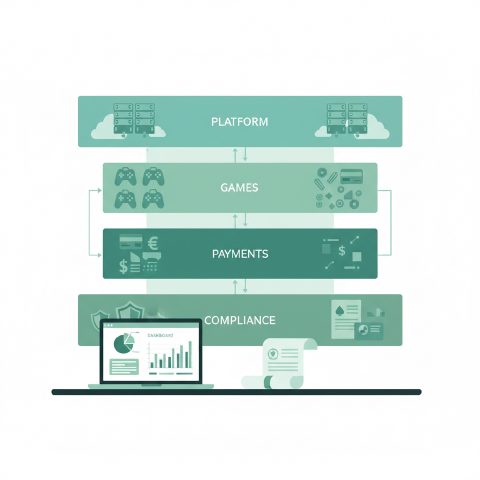
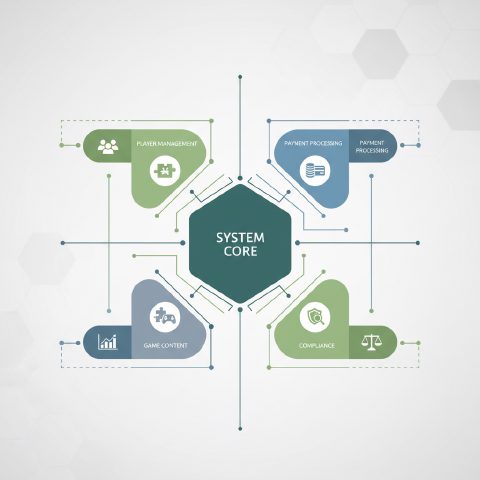
The PAM sits at the center of your stack, integrating outward to four key systems: your game aggregator (via a unified wallet API), your payment gateway or PSP layer, your KYC and AML providers, and your front-end or CMS. Every player action flows through the PAM. Get the integration architecture wrong and you will spend months firefighting data inconsistencies.
The most critical integration is between the PAM and the game aggregator. Most aggregators, including Relax Gaming, Pariplay, and SoftSwiss's own Softgamings, use a transfer wallet or seamless wallet model. In a transfer wallet setup, the aggregator holds a separate game balance and the PAM syncs it. In a seamless wallet setup, the aggregator calls the PAM's wallet API on every bet and win. Seamless is cleaner for the player (one balance everywhere) but puts more load on your PAM's API. If your PAM cannot handle the throughput, you get timeout errors that show up as failed spins. That is a player complaint and a potential dispute.
Payment gateway integration is where many operators discover their PAM's limitations. A PAM that only natively integrates with three or four PSPs will constrain your payment strategy. In LATAM markets, for instance, you need local payment methods like PIX in Brazil, PSE in Colombia, or OXXO in Mexico. If your PAM requires a custom integration for each one, your launch timeline and budget will both expand. EveryMatrix's EGS platform maintains a relatively broad native payment integration library, but you should always verify coverage for your specific target markets before committing.
The KYC integration layer is increasingly complex. Regulators in regulated markets want automated identity checks, PEP and sanctions screening, and sometimes biometric verification. The PAM needs to orchestrate these checks at the right points in the player journey: at registration, at first withdrawal, and when a player hits a transaction threshold. A PAM that treats KYC as a single checkbox at registration will not survive a compliance audit in an MGA or UKGC-regulated operation.
What are the main PAM deployment models: white-label, turnkey, or headless?
PAM software comes in three deployment flavors. White-label bundles the PAM with a front-end template and a game library under a shared license, fastest to market but least flexible. Turnkey gives you the full platform under your own brand and license, more control but heavier upfront cost. Headless PAM is a pure back-end API layer you integrate with your own front-end, maximum flexibility but requires real engineering resources.
White-label is the entry point for most first-time operators. Vendors like SoftSwiss, Tain, and ProgressPlay bundle PAM, games, payments, and a front-end template into a monthly fee plus revenue share. You can be live in six to twelve weeks. The trade-off is that you share infrastructure with dozens of other operators, your ability to customize the bonus engine is limited, and the revenue share (typically 15-30% of GGR depending on the vendor) becomes very expensive as your volume grows. White-label makes sense as a market-testing vehicle, not as a long-term operating model for a serious business.
Turnkey platforms give you a dedicated instance of the PAM under your own brand. You still buy the software from a vendor, but you are not sharing a database with competitors. Vendors like Digitain and Pronet Gaming operate in this space. Setup fees are higher (expect $50,000 to $150,000+ for a full turnkey setup, though figures vary significantly by vendor and scope), monthly licensing fees replace or reduce revenue share, and you get more control over configuration. The catch is that you still depend on the vendor's release cycle for new features and bug fixes.
Headless or API-first PAM is the model for operators who want to build a differentiated product. You license the PAM engine, integrate it via API into your own front-end and game aggregator connections, and own the full player experience. This is how most tier-one operators eventually end up. The engineering overhead is real: you need a development team capable of maintaining integrations, and your time-to-market is measured in months, not weeks. But you are not paying a revenue share forever, and you can iterate on product without waiting for a vendor roadmap.
| Model | Time to market | Upfront cost | Revenue share | Customization | Best for |
|---|---|---|---|---|---|
| White-label | 6-12 weeks | Low ($5K-$30K setup) | 15-30% GGR | Low | First-time operators, market testing |
| Turnkey | 3-6 months | Medium ($50K-$150K+) | Low or none | Medium | Funded operators wanting brand control |
| Headless / API-first | 6-12 months | High (dev costs) | None | Full | Established operators, differentiated products |
Which PAM vendors should operators evaluate in 2026?
The shortlist most operators should benchmark includes SoftSwiss, EveryMatrix (EGS), Digitain, Pronet Gaming, BtoBet, and Altenar for sportsbook-heavy builds. Each has different strengths: SoftSwiss dominates crypto-friendly white-label, EveryMatrix has the deepest game aggregator integration, and Digitain competes hard on price for emerging market operators.
SoftSwiss is the name that comes up most often in offshore and crypto casino builds. Their platform handles crypto natively, they have a large library of pre-integrated game studios, and their white-label product is genuinely fast to deploy. The revenue share model gets expensive at scale, and their reporting suite is less sophisticated than some competitors for regulated market compliance. If you are launching a Curaçao-licensed crypto casino and want to move fast, SoftSwiss is a rational starting point. If you are targeting MGA or a US state license, you need to do more due diligence on their compliance tooling.
EveryMatrix runs a modular architecture where the PAM (their CasinoEngine or CardsChat layer) sits alongside their game aggregator (GameMount), sportsbook (OddsMatrix), and payment module (MoneyMatrix). The modularity is genuinely useful: you can license just the PAM and connect your own aggregator, or take the full stack. Their game aggregator integration is one of the broadest in the market, which matters if content breadth is a competitive differentiator in your target market. EveryMatrix is also MGA-certified and has worked with regulated European operators, so their compliance tooling is more mature than some offshore-first vendors.
Digitain and Pronet Gaming compete in the mid-market, particularly in Eastern Europe, Central Asia, and LATAM. Both offer competitive licensing fees and are willing to negotiate on revenue share. BtoBet, now part of the Kambi group, is worth evaluating if you want a PAM with a strong sportsbook integration, particularly for African and LATAM markets where sports betting drives the majority of GGR. For any vendor on your shortlist, I recommend requesting a sandbox environment and testing the bonus engine and wallet API yourself before signing. Vendor demos are polished. Sandboxes reveal the truth.
How does PAM software handle player KYC and AML compliance?
A modern PAM orchestrates KYC by triggering identity verification checks at configurable thresholds, passing player data to third-party verification providers, storing the results against the player record, and blocking restricted actions (withdrawals, higher deposit limits) until checks pass. AML is handled through transaction monitoring rules that flag unusual patterns for manual review or automatic restriction.
The KYC orchestration layer in a PAM needs to be configurable by jurisdiction, because the rules differ dramatically. Under MGA regulations, enhanced due diligence kicks in at specific cumulative deposit thresholds. Under UKGC rules, you need affordability checks for players who hit certain loss levels. In Colombia under Coljuegos, operators must report player data to a central government system. A PAM that has a single global KYC configuration cannot serve a multi-jurisdiction operation without significant customization work.
Third-party KYC providers that PAMs commonly integrate with include Jumio, Onfido, Sum and Substance (particularly popular in Eastern European and CIS markets), and Shufti Pro. The PAM should store the raw KYC result, the provider used, the timestamp, and the document type verified. Regulators can and do ask for this data during audits. If your PAM only stores a binary pass/fail flag, you have a compliance gap that will surface at the worst possible time.
AML transaction monitoring is an area where many smaller PAM vendors are genuinely weak. The minimum you need is configurable velocity rules (flagging a player who deposits five times in an hour, for example), structuring detection (multiple deposits just below a reporting threshold), and PEP and sanctions list screening at registration and on an ongoing basis. Some PAMs outsource AML monitoring to a third-party module like SEON or ComplyAdvantage. That is fine architecturally, but you need to verify the integration is real-time, not a nightly batch job. A batch-job AML check will not satisfy a regulator in any serious jurisdiction.
What does PAM software cost, and how is it typically priced?
PAM pricing follows three models: revenue share (typically 10-30% of GGR for white-label), fixed monthly licensing fees (ranging from a few thousand dollars to $50,000+ per month for enterprise turnkey), or a hybrid of setup fee plus lower revenue share. Crypto and offshore white-label products sit at the lower end. Regulated market enterprise platforms sit at the higher end.
Revenue share pricing looks cheap at launch and becomes expensive fast. If your casino generates $500,000 GGR per month and you are paying 20% to your PAM vendor, that is $100,000 per month, or $1.2 million per year, for a platform you do not own. Most operators who start on revenue share white-label and grow to meaningful volume eventually migrate to a fixed-fee or owned platform. The migration is painful and expensive, but the math forces it. Build that migration cost into your business plan from day one.
Fixed monthly licensing fees are harder to negotiate at small volume but become significantly more favorable as you scale. Vendors like Digitain and Pronet Gaming are generally more willing to negotiate flat-fee structures than the larger white-label platforms. Setup fees for a full turnkey implementation vary widely depending on the number of payment integrations, custom front-end work, and regulatory certification requirements. Getting itemized quotes from at least three vendors before signing is basic due diligence that many operators skip because they are in a hurry to launch.
There are also indirect costs that vendors do not advertise. Integration work for custom payment methods, additional KYC provider connections, or bespoke reporting formats will typically be quoted as professional services at $100-$200+ per hour. Ongoing support SLAs matter too: if your PAM goes down on a Saturday night and your support contract only covers business hours, you will learn about that gap at the worst possible moment. Always read the SLA section of a vendor contract before the commercial section.
How does PAM software differ from a CRM or a casino management system?
PAM is the authoritative system of record for player accounts and balances. A CRM is a marketing and communication layer that reads from the PAM but does not own financial data. A casino management system (CMS) is a broader term that sometimes means the same as PAM, sometimes includes front-end content management, and sometimes refers to land-based casino operations software. The terms overlap, but the distinctions matter when you are scoping a build.
The confusion between PAM and CRM is common and consequential. A CRM like Optimove or Fast Track reads player behavioral data from the PAM to power segmentation, lifecycle campaigns, and retention workflows. It does not hold wallet balances or enforce bonus wagering rules. If you are evaluating a vendor who tells you their CRM is their PAM, ask them where the wallet ledger lives. That question will clarify the architecture quickly.
Casino management system is a term that originated in land-based casino operations, where it refers to the software managing slot machines, table games, chips, and floor operations. In the online context, vendors have borrowed the term to describe full-stack platforms that include PAM, front-end CMS, game management, and reporting. When an online vendor says CMS, they usually mean something closer to what I would call a platform or turnkey solution. The PAM is the data layer within that broader system.
Sportsbook platforms add another layer of complexity. A PAM for a combined casino and sportsbook needs to handle a single wallet across both verticals, which requires tight integration between the PAM and the sportsbook risk management engine. Vendors like BtoBet and Altenar have built this integration natively. If you are buying a casino PAM and a sportsbook from two different vendors and expecting them to share a wallet seamlessly, budget for significant integration work. It is achievable, but it is not free.
What PAM features are required for specific regulated markets?
Regulated markets impose specific technical requirements on PAM software that go beyond generic compliance tooling. MGA requires certified responsible gambling controls and AML transaction monitoring. UKGC mandates affordability checks and self-exclusion integration with GAMSTOP. Spanish DGOJ and Colombian Coljuegos require real-time data feeds to government monitoring systems. US state licenses add geolocation enforcement and state-specific self-exclusion registries.
The MGA (Malta Gaming Authority) is one of the most rigorous frameworks for PAM certification. An MGA-licensed operator must demonstrate that their PAM enforces deposit limits, session time limits, and self-exclusion at the system level, not just the UI level. The PAM must also produce audit logs in a format the MGA can inspect. Several PAM vendors have pre-certified their platforms with the MGA, which can save an operator three to six months of compliance work. SoftSwiss, EveryMatrix, and Digitain all have MGA-compatible configurations, though you should verify the current status directly with the vendor since certifications can lapse or require version-specific updates.
For US state markets, the technical requirements are set at the state level and vary significantly. New Jersey's Division of Gaming Enforcement (DGE) has detailed technical standards for player account systems, including specific requirements for geolocation verification (typically via a vendor like GeoComply), account authentication, and transaction logging. Michigan and Pennsylvania have similar frameworks. No generic offshore PAM is going to be drop-in compliant with a US state license out of the box. If you are targeting a US state, your PAM vendor needs documented experience with that state's technical standards, or you need to budget for significant compliance engineering.
Curaçao's revised framework, which moved toward an OGL (Online Gaming License) model starting in 2023, now requires operators to demonstrate responsible gambling controls and AML procedures more formally than the old sub-license model did. This raised the bar for offshore PAM vendors who previously operated with minimal compliance tooling. It is not yet MGA-level rigor, but the direction is clear. Operators launching on Curaçao in 2026 should not assume the compliance requirements of 2019 still apply.
What are the most common PAM integration mistakes operators make?
The four mistakes I see most often: choosing a PAM based on the demo rather than the API documentation, underestimating the time required to integrate local payment methods, failing to test responsible gambling enforcement at the wallet level before launch, and not negotiating data portability into the contract before signing.
The demo problem is endemic. Every PAM vendor has a polished demo environment that shows the best-case version of their platform. The bonus engine looks flexible, the reporting looks comprehensive, the KYC flow looks smooth. Then you get into the actual integration and discover that the bonus engine requires a support ticket to change game contribution rates, the reporting module cannot export in the format your regulator requires, and the KYC integration with your preferred provider is not actually built yet. Always ask for sandbox API access before you sign. If a vendor will not give you sandbox access during the sales process, that tells you something.
Payment integration timelines are consistently underestimated. Operators launching in LATAM, for instance, often discover that their PAM vendor's payment module does not natively support the local methods that drive conversion in their target market. PIX in Brazil, PSE in Colombia, and SPEI in Mexico are not optional if you want to compete in those markets. Each integration requires development work, testing, and often a separate commercial agreement with the payment provider. Budget four to eight weeks per new payment method integration, not four to eight days.
Data portability is the contract clause that operators regret not negotiating until they want to switch vendors. If your player data lives in a vendor's proprietary database schema and the contract does not give you the right to export it in a usable format, you are effectively locked in forever. This is not a hypothetical risk. I have seen operators who built a six-figure player base on a white-label platform discover that migrating to a new PAM would require manual re-registration of every player because the vendor's contract did not include data export rights. Negotiate data portability, export formats, and migration assistance into every PAM contract before you sign.




Comments
No comments yet, be the first.