Online Casino Business Plan Template and Model: The 2026 Operator's Blueprint

What Should an Online Casino Business Plan Actually Cover?
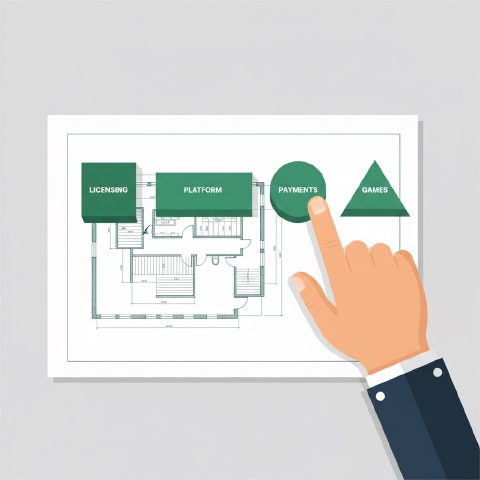
A solid online casino business plan covers six core pillars: corporate and licensing structure, platform and software architecture, game content strategy, payment and banking stack, marketing and acquisition model, and a 24-month financial model with realistic GGR projections. Miss any one of these and you'll face hard questions from regulators, payment processors, or investors at the worst possible moment.
I've reviewed dozens of operator decks over the years and the most common failure mode is a plan that reads like a consumer pitch — lots of market-size statistics, very little operational specificity. Payment processors and licensing bodies don't care that the global online gambling market is worth $100 billion. They want to know your target jurisdiction, your AML program structure, your projected monthly active users in month six, and who your platform provider is. Get those answers on paper before you do anything else.
The six pillars aren't equally weighted. Licensing and corporate structure is foundational — it determines which payment methods you can offer, which markets you can legally target, and what your tax exposure looks like. Platform architecture comes second because it drives your cost structure and time-to-market. Everything else — game mix, bonusing strategy, acquisition channels — flows from those two decisions. A plan that reverses this order, starting with the product vision and treating licensing as an afterthought, is a plan that stalls at the banking stage.
Practically speaking, your business plan document should run 25–45 pages for an operator seeking a license or institutional funding, with a separate financial model spreadsheet. For a white-label launch funded by a single founder, a tighter 15-page version works — but the financial model still needs to be granular. Projecting revenue as a percentage of some industry figure is not a financial model; projecting 1,200 registered users in month three, with a 22% deposit conversion rate, an average first deposit of $85, and a 4.2% GGR margin gets you somewhere useful.
How Do You Choose the Right Licensing Jurisdiction for Your Business Model?
Jurisdiction selection is a cost-versus-market-access trade-off. Curaçao remains the lowest-cost offshore entry point ($15k–$30k setup, 2–4 months), Anjouan has emerged as a cheaper alternative since 2023, and the MGA commands the highest trust with EU payment processors but costs $25k–$50k in fees alone with a 6–12 month timeline. US state licenses are a different category entirely — each state is its own regulatory regime.
The practical question isn't which license is 'best' — it's which license unlocks the payment processing relationships and player markets that match your business model. An MGA license opens doors with Visa, Mastercard, and most EU-facing PSPs, but you're committing to a compliance overhead that can run $10k–$20k per month once you factor in a compliance officer, responsible gambling tools, and the MGA's technical audit requirements. For a bootstrapped launch targeting crypto-native players in unregulated markets, that overhead kills your unit economics before you acquire your first player.
Curaçao's Gaming Control Board (GCB) underwent a significant regulatory overhaul in 2023, moving from the old master-license sublicense model to direct operator licenses. The new framework is more credible than the old one, but processing relationships with major card networks are still harder to secure than with MGA. Anjouan (issued by the Anjouan Gambling Authority) is cheaper still — setup fees can be under $10k — but processor acceptance is narrower, so it works best for crypto-first or voucher-based payment models.
US state licenses are a separate conversation. New Jersey, Pennsylvania, Michigan, and Connecticut have live regulated iGaming markets with licensing costs that vary dramatically — NJ requires a transactional waiver or full casino license tied to a land-based partner, which is a multi-year, multi-million-dollar path. If your plan targets US players, you need a market-entry section that is honest about whether you're building toward a regulated US partnership or operating offshore. Conflating the two in a single plan is a red flag to anyone who reads it carefully.
| Jurisdiction | Setup Cost (est.) | Timeline | Annual Fee (est.) | Card Processing Access | Best For |
|---|---|---|---|---|---|
| Curaçao (GCB) | $15k–$30k | 2–4 months | $10k–$15k | Limited — crypto/alt-PSP friendly | Offshore, crypto-first, bootstrap launches |
| Anjouan | $8k–$15k | 1–3 months | $5k–$10k | Narrow — crypto/voucher focused | Lowest-cost entry, crypto-native operators |
| Malta (MGA) | $25k–$50k in fees | 6–12 months | $25k+ | Strong — Visa/MC/EU PSPs | EU-facing, regulated market operators |
| Isle of Man (GSC) | $30k–$60k | 6–9 months | $20k–$35k | Strong | UK/EU operators, established businesses |
| US State (e.g., NJ, PA) | $500k–$2M+ | 12–36 months | Varies by state | Full domestic banking | Well-capitalized operators with land-based partners |
White-Label, Turnkey, or Custom Build — Which Platform Model Fits Your Business Plan?
White-label is the fastest and cheapest path to launch ($30k–$80k, 4–12 weeks), but you sacrifice margin and control. A turnkey solution from providers like SoftSwiss or EveryMatrix sits in the middle — more flexibility, $100k–$300k setup range, 3–6 months. Custom builds start at $500k and take 12–24 months. Your business plan must justify the choice with numbers, not preference.
The white-label model means you're essentially renting a casino under someone else's platform license and tech stack. Providers like Income Access, Jumpman Gaming, or various Curaçao-licensed white-label operators handle the platform, some compliance, and often the payment processing — you handle marketing and player relationships. The royalty structure typically runs 15–35% of GGR, which sounds manageable until you model it at scale. At $500k annual GGR, a 25% royalty is $125k off the top before you pay a single acquisition cost. That math works for a founder testing a market; it doesn't work for a business planning to grow past $2M GGR.
Turnkey platforms from providers like SoftSwiss (SOFTSWISS Casino Platform), EveryMatrix (CasinoEngine), Digitain, or BetConstruct give you your own license, your own player database, and full control over the product. You pay a setup fee, a monthly platform fee (often $5k–$20k/month depending on scale), and a smaller revenue share or flat fee per game API call. The trade-off is that you own the compliance obligation entirely — your AML program, your KYC tooling, your responsible gambling implementation. That's more work, but it's also a real business asset rather than a rented audience.
Custom builds make sense when you have a genuinely differentiated product that existing platforms can't deliver — a specific live dealer format, a unique loyalty mechanics engine, or a regulated US market entry where you need proprietary integrations with state-specific systems. Don't let a technology vendor talk you into a custom build because it 'gives you more flexibility.' Flexibility you don't use is just cost. In your business plan, if you're proposing a custom build, you need a concrete feature list that explains why no existing platform can deliver it and a technical team budget that includes ongoing maintenance, not just the build cost.
| Model | Setup Cost | Time to Launch | GGR Revenue Share | Compliance Ownership | Scalability |
|---|---|---|---|---|---|
| White-Label | $30k–$80k | 4–12 weeks | 15–35% of GGR | Shared / provider-led | Limited — capped by provider terms |
| Turnkey (e.g., SoftSwiss, EveryMatrix) | $100k–$300k | 3–6 months | Low flat fee or small rev share | Operator-owned | High — full product control |
| Custom Build | $500k+ | 12–24 months | None (you own the stack) | Fully operator-owned | Maximum — but expensive to maintain |
How Do You Build a Realistic Revenue Model for an Online Casino?
Online casino revenue is driven by GGR (Gross Gaming Revenue = bets minus winnings), which is then reduced by bonuses, payment fees, platform royalties, and taxes to reach NGR (Net Gaming Revenue). A realistic model starts with player acquisition projections, applies realistic conversion and activity rates, and derives GGR from average bet size and game RTP — not from market-size percentages.
The mechanics: if you acquire 500 depositing players in month one with an average first deposit of $100, and your casino's blended hold percentage across slots (typically 4–6% house edge) and table games (1–3%) runs around 4.5%, you're looking at roughly $2,250 in GGR from that cohort's first-session play. That's before bonuses — and bonuses typically reduce effective GGR by 20–40% in competitive markets where welcome packages are aggressive. So your real month-one GGR from that cohort might be $1,350–$1,800. Now subtract a 25% platform royalty, 4% payment processing, and you're looking at net revenue per acquired player that makes your $300 CPA look very uncomfortable in the short term.
The business only works on lifetime value, which is why your financial model needs cohort retention assumptions, not just acquisition numbers. Industry benchmarks suggest that a well-run online casino retains roughly 20–30% of first-time depositors as 90-day active players, and the top 10% of players typically generate 50–60% of GGR. Your plan should model at least three player segments: high-value (VIP), regular, and casual — with different average bet sizes, session frequencies, and churn rates for each. Flat-average models consistently overstate revenue in the early months and understate it at scale.
On the cost side, the line items that operators most consistently underestimate are: affiliate commissions (CPA deals of $200–$600 per depositing player, or revenue share deals of 25–45% of NGR for life); payment processing fees that compound across deposit, withdrawal, and chargeback costs; and the ongoing cost of game content — aggregators like Relax Gaming, Paysafe's Paysafecard, or direct deals with studios like Pragmatic Play carry monthly minimum guarantees that don't care about your player volumes. Build a 24-month P&L with monthly granularity and stress-test it at 50% of your acquisition projection. If the business doesn't survive that scenario, you need more capital or a lower cost structure before you launch.
What Game Content Strategy Should Your Business Plan Specify?
Your game content plan needs to specify aggregator versus direct studio deals, the initial game library size (300–500 titles is a credible minimum for a general-audience casino), and which verticals you're prioritizing — slots, live dealer, table games, or sports. Aggregators like SoftSwiss Game Aggregator, Relax Gaming, or EveryMatrix's GameHub give you 5,000+ titles through one integration, which is almost always the right call at launch.
The aggregator model is the standard for any new operator. You sign one contract, complete one technical integration, and access content from dozens of studios — Pragmatic Play, Evolution Gaming, Play'n GO, NetEnt, and hundreds of others. The cost is a revenue share (typically 10–20% of GGR from aggregated content) plus sometimes a monthly minimum. The alternative — direct studio deals — makes financial sense only when you're doing enough volume with a specific studio that the direct rate beats the aggregator blended rate, which generally means $1M+ annual GGR from that studio's content. Before that threshold, direct deals just create integration overhead without meaningful cost savings.
Live dealer is worth calling out specifically because it's become a table-stakes category — players expect it, and it drives disproportionate GGR from high-value segments. Evolution Gaming holds a dominant market position in live dealer; their products are excellent but their commercial terms reflect that dominance. Pragmatic Play Live and Ezugi (owned by Evolution, ironically) offer more competitive entry-level deals. If your business plan targets a market where live dealer is a primary acquisition driver — LATAM, for instance — budget for live dealer content costs explicitly rather than lumping it into a blended aggregator rate.
Jurisdiction matters enormously for game content. MGA-licensed operators can offer Evolution, Pragmatic, and essentially every major studio. Curaçao operators face some studio restrictions — a handful of major providers won't supply content to Curaçao-licensed operators or require specific sub-agreements. Your business plan should include a content availability matrix for your target jurisdiction, because discovering post-launch that your preferred studio won't supply you is an expensive surprise. Ask your aggregator for a definitive list of available studios under your specific license before you sign anything.
How Should You Structure the Payment and Banking Section of Your Plan?
The payment section is where most online casino business plans are weakest and where processors do the most due diligence. You need to specify at minimum: your acquiring bank or PSP, your primary deposit methods by target market, your withdrawal infrastructure, and your fraud and chargeback management approach. Vague language about 'accepting all major payment methods' will get your application rejected.
Online gambling is a high-risk merchant category. Most mainstream payment processors won't touch you, and the ones that will charge accordingly — card processing fees for gambling merchants typically run 3–6% for deposits, with additional chargeback fees and rolling reserves (5–10% of volume held for 90–180 days) that create real cash flow pressure in the early months. Processors that actively work with online casino operators include Payvision, Nuvei, Paydoo, Trustly (for open banking in EU markets), and a range of crypto payment processors. Your plan should name your primary processor and your backup — single-processor dependency is an operational risk that sophisticated reviewers will flag.
Crypto payments deserve a serious section if your target market or licensing jurisdiction is crypto-friendly. Curaçao and Anjouan-licensed operators often rely heavily on crypto precisely because card processing relationships are harder to establish. Processors like CoinsPaid, BitPay, or direct wallet integrations (USDT, BTC, ETH) can handle the majority of transaction volume for crypto-native audiences at fees of 0.5–1.5% — materially better economics than card processing. The trade-off is that crypto-only or crypto-heavy operations have a narrower total addressable market; not all players use crypto, and conversion from fiat to crypto adds friction that increases dropout rates at deposit.
The AML and KYC section of your payment plan is not optional even if your jurisdiction's requirements are light. Payment processors conduct their own due diligence on your AML program — they want to see transaction monitoring thresholds, source-of-funds procedures for high-value players, and a named compliance officer or outsourced compliance provider. Providers like Jumio, Sumsub, or Onfido handle KYC verification; ComplyAdvantage or Refinitiv handle AML screening. Budget $2k–$5k/month for these tools at a lean launch scale. Omitting this from your business plan signals to anyone reading it that you haven't actually launched a gambling business before.
What Does a Realistic Online Casino Marketing and Acquisition Plan Look Like?
A credible acquisition plan specifies channels (SEO, affiliates, paid social, influencer, email), realistic CPAs or revenue share rates by channel, a first-year player acquisition target broken into monthly cohorts, and a retention and reactivation strategy. Affiliate marketing dominates iGaming acquisition — most established operators drive 60–80% of new depositors through affiliate networks, with CPA deals ranging $150–$600 depending on market.
Affiliates are the backbone of online casino acquisition because the economics work for both sides when managed properly. On a CPA model, you pay a fixed amount per first-time depositor — typically $200–$400 for tier-2 markets, $400–$600 for competitive markets like the UK or Germany. On a revenue share model, you pay the affiliate 25–45% of NGR from their referred players for the lifetime of those players. Revenue share is cheaper upfront but creates a long-tail cost that compounds as your player base grows; CPA is predictable but requires capital. Your business plan should model both scenarios and specify which you'll lead with, and why. Most new operators start with revenue share to conserve cash, then shift toward CPA as they establish track record with affiliates.
SEO is the highest-ROI long-term channel but the slowest to build. A new casino domain with no history will take 12–18 months to rank for meaningful commercial terms, even with aggressive content investment. If your financial model depends on organic traffic in months 3–6, it's wrong. Budget for paid acquisition in the first year — paid social (Meta, TikTok depending on jurisdiction), display networks, and influencer partnerships — and treat SEO as a 12–24 month investment that reduces your paid acquisition dependency over time.
Retention is systematically underweighted in first-time operator plans. Acquiring a player costs $200–$600; reactivating a lapsed player who already trusts your brand costs $10–$30. Your CRM strategy — welcome sequences, deposit match triggers, VIP tier mechanics, and reactivation campaigns — should be specified in your plan with concrete bonus budget allocations. A rule of thumb: bonus costs should run 15–25% of GGR in a competitive market. If your model shows bonus costs below 10%, you're probably underestimating the promotional pressure needed to compete for player attention.
How Do You Build the Financial Model Section — P&L, Cash Flow, and KPIs?
Your financial model needs three outputs: a 24-month P&L, a cash flow statement (critical because of rolling reserves and delayed revenue), and a KPI dashboard tracking GGR, NGR, active players, CPA, LTV, and churn. Build it monthly, not quarterly. The first 6 months will almost certainly be cash-flow negative — your plan should show you know that and have the capital to cover it.
The P&L structure for an online casino looks like this: start with Gross Gaming Revenue, subtract bonus costs to get Net Gaming Revenue, subtract platform royalties/fees, payment processing costs, and game content fees to get Gross Profit. From there, subtract marketing and acquisition costs, staffing (customer support, compliance, operations), technology and hosting, licensing and regulatory fees, and G&A to reach EBITDA. In the first year, EBITDA is almost always negative for a new operator — the question is how negative and for how long. A well-structured plan shows breakeven at month 14–20 for a white-label operation, month 18–30 for a turnkey setup, depending on market competitiveness and acquisition efficiency.
Cash flow is a separate and equally important model. Rolling reserves held by payment processors — typically 5–10% of card volume for 90–180 days — create a cash drag that doesn't show up in the P&L but can kill an undercapitalized operator. If you're processing $200k/month in card deposits with a 10% rolling reserve, you have $20k/month tied up in reserve that you can't touch for six months. Model this explicitly. Similarly, affiliate CPA payments are often due net-30 or net-45, while your GGR is earned in real time — the timing mismatch matters for cash planning.
Key KPIs to track and include in your plan: Monthly Active Players (MAP), Average Revenue Per User (ARPU), First-Time Depositor count (FTD), Deposit Conversion Rate (registered users who deposit — benchmark 15–25% for a well-optimized funnel), Average Deposit Value, GGR per Active Player, Bonus Cost as % of GGR, and Customer Acquisition Cost (CAC). If you're presenting to investors or a licensing body, these KPIs demonstrate that you understand the operational mechanics of the business, not just the market opportunity. Projections without KPI benchmarks are just guesses dressed up as a model.
| KPI | Early Stage (Months 1–6) | Growth Stage (Months 7–18) | Notes |
|---|---|---|---|
| Monthly Active Players | 100–500 | 500–3,000 | Highly market-dependent |
| Deposit Conversion Rate | 12–20% | 18–28% | Improves with UX optimization and trust signals |
| Average First Deposit | $60–$120 | $80–$150 | Varies by market and acquisition channel |
| GGR Margin (blended) | 3.5–5.5% | 4–6% | Slots skew higher; live dealer lower |
| Bonus Cost as % of GGR | 25–40% | 15–30% | Front-loaded in early months due to welcome offers |
| Customer Acquisition Cost (CAC) | $250–$500 | $200–$400 | Improves as SEO and retention scale |
| Monthly Churn (active players) | 35–55% | 25–40% | Retention programs reduce this over time |
What Staffing and Operational Structure Does Your Plan Need to Address?
A lean online casino launch needs at minimum: a compliance officer (or outsourced compliance firm), a customer support team (even if outsourced), a CRM/marketing manager, and a technical contact for platform issues. Trying to run all of these as a solo founder is how operators get fined, banned from processors, or burned by player complaints that escalate to the regulator.
The compliance function is non-negotiable and chronically understaffed at new operations. Your AML program requires someone accountable — a named Money Laundering Reporting Officer (MLRO) in MGA and most serious jurisdictions. This can be outsourced to a compliance consultancy (budget $3k–$8k/month for a retainer with a firm like Pentasia, Compliance Associates, or a boutique iGaming compliance provider), but someone has to own it. Licensing bodies will ask for the MLRO's CV and qualifications as part of the application. 'We'll hire someone after we get the license' is not an acceptable answer.
Customer support is the other area where operators chronically underinvest. Live chat support is expected 24/7 in competitive markets. At launch scale (under 1,000 active players), you can manage with a small outsourced team — BPO providers with iGaming experience include companies in the Philippines, Eastern Europe, and South Africa that run $8–$15 per agent-hour. Budget for multilingual support if you're targeting multiple markets; a German player who gets English-only support will churn and leave a negative review. Factor support costs into your P&L from day one.
On the technical side, your platform provider handles most infrastructure, but you still need someone who can manage the relationship, monitor uptime, escalate incidents, and handle the integration touchpoints with your payment processors and game aggregators. At a white-label operation, this can be a part-time technical project manager. At a turnkey or custom operation, you need at least one full-time technical operations person. This role is easy to omit from a business plan because it doesn't fit neatly into marketing or compliance — don't omit it.
What Are the Most Common Mistakes Operators Make in Their Casino Business Plans?
The five mistakes I see most often: projecting revenue from market-size percentages rather than player-level unit economics; ignoring the cash flow impact of payment processor rolling reserves; underestimating compliance costs; treating the licensing decision as a formality rather than a foundational business decision; and writing a plan that reads like a consumer pitch rather than an operational blueprint.
The market-size mistake is the most common and the most damaging. Writing 'the global online gambling market is worth $95 billion and we're targeting 0.1% market share' tells a sophisticated reader nothing useful and signals that the founder hasn't done the work. Replace it with: 'We're targeting the German-speaking market in Austria and Switzerland with a Curaçao-licensed operation, projecting 1,800 first-time depositors in year one at an average CPA of $280, generating approximately $380k in NGR.' That's a business plan. The other is a wish.
Rolling reserves blindside more operators than almost any other cost. I've seen well-funded launches hit a cash crisis in month four because they didn't model the 10% rolling reserve on card volume. If your plan projects $300k in monthly card deposits by month six, you need to show that you have the liquidity to have $180k+ tied up in reserve at any given time. Payment processors don't negotiate this away for new operators — it's their risk management tool, and it's standard. Show in your cash flow model that you've accounted for it.
Finally, the plan that reads like a consumer pitch. I understand the instinct — you're excited about the product, the brand, the player experience. But your licensing body wants to know your AML thresholds. Your payment processor wants to know your chargeback management process. Your potential co-founder or investor wants to know your path to profitability. Write the plan for those audiences, not for a player who might one day enjoy your casino. The product vision belongs in an appendix; the operational and financial substance belongs in the main document.



Comments
No comments yet, be the first.